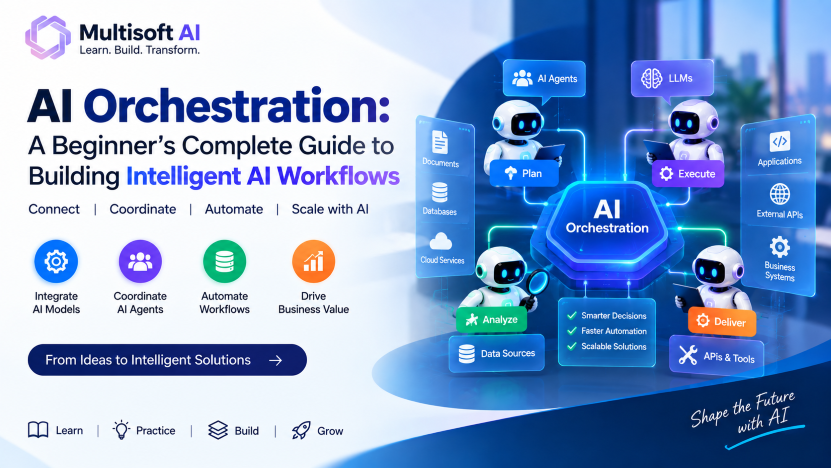
AI Orchestration: A Beginner's Complete Guide to Building Intelligent AI Workflows
Artificial Intelligence is moving beyond simple question-and-answer applications. Modern AI solutions can connect multiple models, agents, APIs, databases and business applications to complete complex tasks. This has created growing interest in AI orchestration, an approach that helps organizations coordinate different AI capabilities within a single workflow. For beginners, AI orchestration can seem complicated because it involves several technologies at once. However, the basic idea is straightforward: instead of asking one AI model to perform every task independently, orchestration connects the right models, agents, tools and data sources so they can work together in an organized way.
Multisoft AI's AI Orchestration Training introduces learners to this concept through AI workflow design, LLM integration, agent coordination, API connectivity, automation and deployment. The program also includes practical projects and hands-on learning to help participants understand how orchestration can be applied to real business environments.
What Is AI Orchestration?
AI orchestration Training is the process of coordinating AI models, agents, APIs, data sources and workflows to complete complex tasks and deliver end-to-end solutions. Instead of treating each AI component as an isolated system, orchestration creates a structured flow in which different components can perform specific responsibilities. For example, consider an intelligent customer support workflow. One AI component may identify the customer's request, another may search a knowledge base, another may analyze the information and another may prepare the response. An orchestration layer can manage how these components interact and determine what happens at each stage. This makes AI orchestration particularly useful for applications that involve multiple steps, decision-making, external tools or several AI capabilities.
Why Is AI Orchestration Important?
As AI applications become more sophisticated, organizations need more than individual AI models. Businesses often need systems that can connect models with internal information, applications and automated processes. AI orchestration helps create this connection by providing a structured approach to managing AI workflows.
Some important reasons for using orchestration include:
- Workflow Coordination - Connect multiple AI tasks into a single process.
- Agent Collaboration - Allow AI agents to communicate and work together.
- Model Integration - Connect different AI models based on specific requirements.
- Business Automation - Automate complex processes involving several steps.
- Data Connectivity - Connect AI applications with databases and information sources.
- API Integration - Allow AI systems to communicate with external applications.
- Scalability - Create workflows that can grow as business requirements change.
- Monitoring - Track workflow performance and identify problems.
AI Orchestration vs AI Automation
AI automation and AI orchestration are related but they are not exactly the same. AI automation focuses on using AI to perform tasks with less human involvement. For example, an AI system may automatically classify customer emails or summarize documents. AI orchestration takes a broader approach. It coordinates several AI models, agents, tools, APIs and workflows so they can work together. A simple automation might involve one AI model performing one task. An orchestrated workflow can involve multiple stages where the output from one component becomes the input for another. Therefore, orchestration can be considered an important layer for managing more complex AI-powered automation.
Core Components of AI Orchestration
Understanding the main components makes AI orchestration easier for beginners.
- Large Language Models
Large Language Models provide language understanding and generation capabilities. They can analyze instructions, generate responses, summarize information and support reasoning-based tasks. An orchestration workflow can connect one or more LLMs depending on the requirements of an application.
- AI Agents
AI agents can perform specific tasks within an AI workflow. They may use models, tools and external information to complete their assigned responsibilities. Multiple agents can be coordinated to handle different stages of a complex process.
- APIs
APIs allow AI workflows to communicate with external applications and services. They can be used to retrieve information, send data or trigger actions in another system.
- Data Sources
AI applications often require access to databases, documents, knowledge bases or other information sources. Orchestration helps connect these resources to the workflow.
- Workflow Engine
The workflow layer determines how tasks are organized and executed. It can manage sequences, conditions, events, retries and dependencies.
- Monitoring and Logging
Monitoring helps developers understand what is happening inside an AI workflow. Logs can provide information about execution, errors, performance and system behavior.
How Does AI Orchestration Work?
An AI orchestration workflow generally begins with a trigger or user request. The orchestration layer then determines which components should handle the task.
A typical workflow may follow these steps:
- Receive Input - The system receives a request, event or business task.
- Understand the Requirement - An AI model or agent interprets the request.
- Plan the Workflow - The system determines the required actions.
- Select Tools or Models - Appropriate AI models, APIs or tools are selected.
- Execute Tasks - Individual components perform their assigned responsibilities.
- Share Information - Results are passed between different workflow stages.
- Validate Output - The system checks whether the expected result has been produced.
- Complete the Process - The final response or business action is delivered.
This structured process allows organizations to create AI solutions that can manage tasks beyond simple text generation.
AI Workflow Design
Workflow design is an important part of AI orchestration. A well-designed workflow defines what should happen, when it should happen and which component should perform each task.
Important concepts include:
- Task planning
- Task execution
- Workflow dependencies
- Event-driven workflows
- Conditional processing
- Error handling
- Retry mechanisms
- Output validation
- Human approval
For beginners, learning workflow design provides a foundation for creating reliable AI applications instead of simply connecting AI tools without a clear structure.
AI Agents and Multi-Agent Systems
AI orchestration becomes particularly powerful when multiple agents are involved. Each agent can focus on a specific responsibility while the orchestration layer manages communication and workflow execution.
For example, an AI research workflow could include:
- Research Agent - Finds relevant information.
- Analysis Agent - Examines the collected data.
- Planning Agent - Determines the next steps.
- Writing Agent - Creates the final document.
- Review Agent - Checks the output.
The orchestration system coordinates these agents so the complete process can operate as one connected workflow. Multisoft AI's training specifically covers agent communication, collaboration, multi-agent orchestration, memory and context management as part of its AI agents module.
Prompt Engineering and Context Management
AI orchestration also depends on effective communication with AI models. Poor instructions can produce inconsistent results even when the overall workflow is well designed. Prompt engineering helps developers create clear instructions for AI models. Context management ensures that models and agents receive the information they need at the right stage of the workflow.
Important areas include:
- Writing clear prompts
- Managing context
- Understanding token limits
- Selecting appropriate models
- Evaluating model responses
- Maintaining relevant information between workflow stages
These skills become increasingly important when multiple AI components depend on each other's outputs.
APIs and External Integrations
AI applications rarely operate completely on their own. They often need to communicate with existing software, databases and online services. APIs and webhooks help establish these connections. An orchestrated workflow can use them to retrieve information, update records or trigger actions in external systems.
Common integration areas include:
- REST APIs
- Webhooks
- Databases
- External AI models
- Business applications
- Third-party tools
- Cloud services
Multisoft AI's AI Orchestration Training covers REST APIs, webhooks, database connectivity, external services, AI model integration and third-party tool integration.
Popular AI Orchestration Frameworks
Several frameworks can help developers create AI-powered workflows and agent-based applications. The right framework depends on the application's architecture and requirements.
- LangChain
LangChain provides components for developing applications powered by language models. It can help developers connect models with tools, data and application workflows.
- LangGraph
LangGraph focuses on building structured and stateful AI workflows. It is particularly useful when developers need greater control over agent execution and workflow state.
- Microsoft Semantic Kernel
Semantic Kernel provides tools for integrating AI capabilities into applications and connecting models with functions and business processes.
- CrewAI
CrewAI supports collaborative AI agent workflows where specialized agents can work together to complete tasks.
- AutoGen
AutoGen is designed for applications where multiple AI agents can communicate and collaborate on complex tasks. Multisoft AI's course introduces learners to LangChain, LangGraph, Microsoft Semantic Kernel, CrewAI and AutoGen as part of its AI orchestration framework module.
Enterprise Applications of AI Orchestration
AI orchestration can support a wide range of business processes because it connects AI capabilities with existing systems.
- Customer Support
An orchestrated system can classify customer requests, retrieve relevant information, generate responses and escalate complex cases.
- Document Processing
AI workflows can extract information from documents, summarize content, validate data and send structured results to another system.
- Business Process Automation
Organizations can combine AI agents, APIs and business applications to automate multi-step operational processes.
- Intelligent Research
AI agents can collect information, analyze findings and prepare reports through a coordinated workflow.
- Decision Support
Orchestrated AI systems can combine data analysis with model-generated insights to support business decisions.
- Software Development
Different AI components can assist with requirements analysis, coding, testing, documentation and review.
- Security and Compliance
AI orchestration can connect models with sensitive business data and external systems. As a result, security should be considered during the design stage rather than added later.
Organizations should consider:
- Access controls
- Data protection
- API security
- Authentication
- Compliance requirements
- Activity monitoring
- Secure deployment
- Appropriate human oversight
A production AI workflow should be designed to prevent unauthorized access and reduce the risk of incorrect or unintended actions.
Monitoring and Performance Optimization
An AI workflow can contain many components. If one part fails, the complete process may be affected. Monitoring therefore plays an important role in production AI systems.
Developers can monitor:
- Workflow execution
- API calls
- Model responses
- Agent activity
- Processing time
- Errors
- Resource usage
- Overall system performance
Optimization may involve selecting appropriate models, reducing unnecessary calls, improving prompts or redesigning inefficient workflow stages.
Practical Projects for Beginners
Practical projects are useful for understanding how individual concepts work together. Multisoft AI's program includes projects such as an AI customer support assistant, document processing workflow, intelligent business process automation and a multi-agent AI project. It also includes an end-to-end AI orchestration capstone project.
A beginner could start with a simple workflow such as:
User Request → AI Agent → Knowledge Source → Analysis → Response
After understanding this structure, additional components such as APIs, multiple agents, databases and human approval can be introduced.
Who Should Learn AI Orchestration?
AI orchestration is relevant to professionals who want to work with AI workflows and intelligent automation.
It can be useful for:
- AI Engineers
- Software Developers
- Data Scientists
- Automation Specialists
- DevOps Engineers
- Cloud Engineers
- IT Professionals
- Generative AI Developers
- Machine Learning Professionals
- Technical Consultants
According to Multisoft AI, a basic understanding of Python, AI/ML concepts, APIs and software development is recommended. However, the course begins with foundational concepts, making it suitable for motivated beginners.
Skills You Can Develop
A structured learning path can help beginners develop several practical capabilities:
- Understanding AI orchestration architecture
- Designing intelligent workflows
- Working with LLMs
- Applying prompt engineering
- Managing context
- Coordinating AI agents
- Integrating APIs and databases
- Connecting external tools
- Using orchestration frameworks
- Deploying AI workflows
- Monitoring AI applications
- Troubleshooting workflow problems
- Building enterprise AI solutions
These skills can provide a strong foundation for moving from basic AI experimentation toward practical AI application development.
Career Opportunities
As organizations explore AI agents and automated workflows, knowledge of orchestration can complement several technology roles.
Potential career paths include:
- AI Engineer - Develops AI-powered applications and workflows.
- AI Agent Developer - Builds intelligent agents for specific business tasks.
- Generative AI Engineer - Develops applications using LLMs and AI tools.
- AI Automation Engineer - Designs intelligent business automation workflows.
- AI Solutions Architect - Plans enterprise AI architectures and integrations.
- Machine Learning Engineer - Integrates machine learning capabilities into applications.
- AI Consultant - Helps organizations identify and implement AI solutions.
AI orchestration is not limited to one job title. It is a cross-functional skill that can complement software development, cloud, data and automation expertise.
Why Learn AI Orchestration in 2026?
AI development is increasingly moving toward systems that can perform multiple tasks, interact with tools and coordinate different AI capabilities. This creates a need for professionals who understand not only how AI models work but also how complete AI workflows should be designed and managed. Learning orchestration can help professionals understand the relationship between models, agents, APIs, data and business processes. For beginners, the goal should not be to learn every framework at once. A better approach is to first understand the fundamentals of workflow design and then gradually explore agents, APIs, frameworks and deployment.
Why Choose Multisoft AI for AI Orchestration Training?
Multisoft AI's AI Orchestration Training is designed around both foundational knowledge and practical implementation. The program covers AI orchestration architecture, LLMs, workflow design, AI agents, APIs, frameworks, deployment and real-world projects. The training includes 24+ hours of expert-led training, live masterclasses, practical learning, unlimited practice assessments, lifetime LMS access and recorded live sessions. Participants can also build their own AI-powered application during the learning process. Training options include one-to-one sessions, live online instructor-led learning and customized corporate training.
Future of AI Orchestration
The future of AI development is likely to involve increasingly connected systems where models, agents, tools and business applications work together. As these systems become more capable, organizations will need reliable ways to manage workflow execution, security, monitoring and integration. AI orchestration can become an important foundation for this development because it focuses on how different AI capabilities work together rather than treating each model as a standalone solution. For professionals, this means that understanding orchestration can be a valuable addition to existing AI, software development, cloud or automation skills.
Conclusion
AI orchestration provides a structured way to connect AI models, agents, APIs, data sources and workflows to solve complex business problems. It helps organizations move beyond isolated AI applications and create connected systems capable of handling multiple tasks. For beginners, the best starting point is to understand the fundamentals: how AI workflows are designed, how LLMs are integrated, how agents communicate and how APIs connect AI applications with external systems. From there, learners can explore frameworks such as LangChain, LangGraph, Semantic Kernel, CrewAI and AutoGen. Multisoft AI's AI Orchestration Training combines these concepts with practical projects, deployment knowledge and enterprise-focused applications. With a structured learning approach, beginners can develop the foundation needed to understand intelligent workflows and progress toward building practical AI-powered solutions.
About the Author