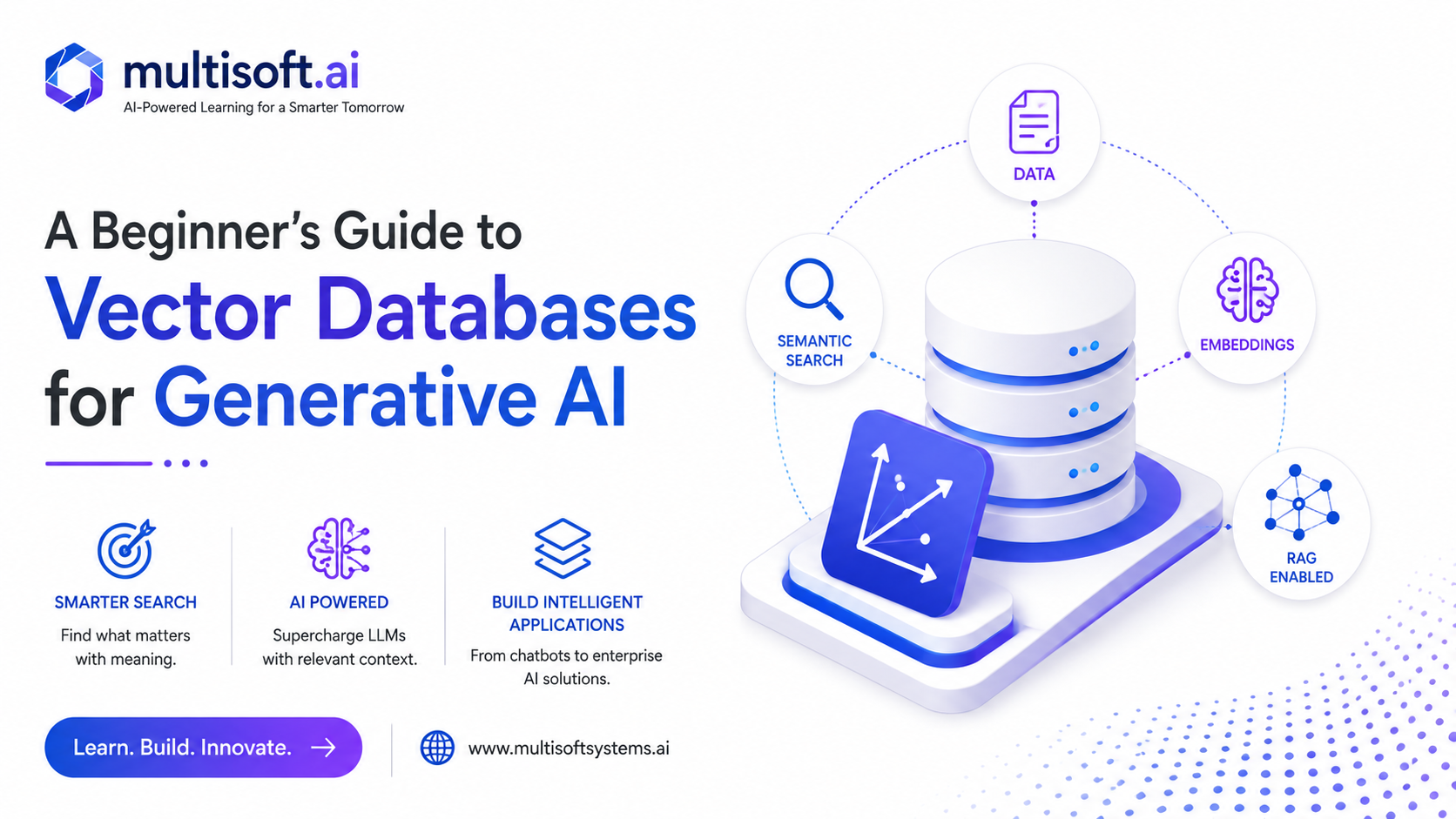
A Beginner's Guide to Vector Databases for Generative AI
Artificial Intelligence is evolving rapidly, and modern AI applications require more than traditional databases to process complex data efficiently. As Large Language Models (LLMs), Retrieval-Augmented Generation (RAG), semantic search, and Generative AI become mainstream, Vector Databases have emerged as a critical technology for storing, indexing, and retrieving high-dimensional data based on meaning rather than exact keywords. Organizations across healthcare, finance, retail, education, and technology are adopting vector databases to build intelligent chatbots, recommendation engines, AI assistants, and enterprise search solutions. As a result, professionals with expertise in Vector Databases are increasingly sought after by employers.
Whether you are a software developer, AI engineer, data scientist, or cloud professional, learning Vector Databases Training can help you build next-generation AI applications and stay competitive in today's AI-driven world. This guide explores the fundamentals, benefits, working principles, and growing importance of vector databases in modern AI development.
What Are Vector Databases?
A Vector Database is a specialized database designed to store, manage, and search high-dimensional vector embeddings generated by Artificial Intelligence and Machine Learning models. Unlike traditional databases that search using exact keywords or structured values, vector databases identify information based on semantic similarity, enabling AI applications to understand the meaning and context of data. Text, images, audio, videos, and documents are converted into numerical vectors called embeddings, allowing the database to compare and retrieve the most relevant results even when exact words do not match. This capability makes vector databases essential for modern AI applications such as semantic search, Retrieval-Augmented Generation (RAG), recommendation systems, AI chatbots, fraud detection, image recognition, and enterprise knowledge management. Popular vector databases include Pinecone, Milvus, Weaviate, Chroma, Qdrant, and FAISS, which are widely used to build scalable, intelligent, and context-aware AI solutions.
Why Vector Databases Are Trending in 2026
The rapid adoption of Generative AI and Large Language Models has significantly increased the demand for technologies that can retrieve accurate and contextually relevant information. Traditional databases struggle to handle semantic searches and unstructured data efficiently, making vector databases a preferred choice for modern AI systems. In 2026, organizations are increasingly integrating vector databases with AI frameworks such as LangChain, LlamaIndex, and Retrieval-Augmented Generation (RAG) pipelines to improve response accuracy and build intelligent applications. As enterprises continue investing in AI-powered automation, personalized search, and knowledge management, vector databases have become a foundational technology for scalable AI development.
Why Vector Databases Are Important in 2026
- Enable semantic search based on meaning instead of exact keywords.
- Improve the accuracy of Retrieval-Augmented Generation (RAG) applications.
- Support Large Language Models (LLMs) with real-time knowledge retrieval.
- Power AI chatbots, virtual assistants, and enterprise AI search systems.
- Handle large volumes of unstructured data efficiently.
- Deliver faster and more relevant search results using vector similarity.
- Integrate easily with AI frameworks such as LangChain and LlamaIndex.
- Enhance recommendation systems for e-commerce, media, and streaming platforms.
- Improve enterprise knowledge management and document search.
- Help organizations build scalable and production-ready AI applications.
How Vector Databases Work
Vector databases Training work by converting data such as text, images, audio, videos, and documents into vector embeddings, which are numerical representations created by Artificial Intelligence models. These embeddings capture the meaning and context of the data rather than just the exact words. When a user submits a search query, the same embedding model converts the query into a vector. The vector database then compares this query vector with millions of stored vectors using similarity algorithms such as Cosine Similarity, Euclidean Distance, or Dot Product to identify the most relevant matches. Instead of searching for exact keywords, it retrieves information based on semantic meaning, making search results more accurate and context-aware. This capability is essential for modern AI applications such as Retrieval-Augmented Generation (RAG), AI chatbots, recommendation systems, enterprise search, and Large Language Model (LLM) applications, where fast and intelligent information retrieval is critical.
Key Features of Vector Databases
- Store and manage high-dimensional vector embeddings efficiently.
- Perform semantic search based on meaning rather than keywords.
- Support Retrieval-Augmented Generation (RAG) applications.
- Deliver fast similarity search using Approximate Nearest Neighbor (ANN) algorithms.
- Handle large volumes of structured and unstructured data.
- Integrate seamlessly with Large Language Models (LLMs).
- Connect with AI frameworks such as LangChain and LlamaIndex.
- Support metadata filtering for more accurate search results.
- Scale efficiently for enterprise AI applications.
- Enable real-time knowledge retrieval.
- Improve recommendation engines and personalization systems.
- Support multimodal data, including text, images, audio, and video.
- Reduce AI hallucinations by retrieving reliable external knowledge.
- Provide APIs for easy integration with business applications.
- Accelerate the development of intelligent AI-powered search and conversational systems.
Vector Databases vs Traditional Databases
| Feature | Vector Databases | Traditional Databases |
| Data Storage | Stores vector embeddings (high-dimensional numerical representations) | Stores structured data in rows and columns |
| Search Method | Semantic similarity search | Exact keyword or value-based search |
| Data Types | Handles text, images, audio, video, and embeddings | Primarily handles structured and relational data |
| AI Integration | Built specifically for AI, LLMs, and RAG applications | Requires additional integration for AI use cases |
| Search Accuracy | Retrieves contextually relevant results | Retrieves only exact or matching records |
| Performance | Optimized for high-speed vector similarity search | Optimized for SQL queries and transactional operations |
| Indexing | Uses ANN, HNSW, IVF, and vector indexing algorithms | Uses B-Tree, Hash, and relational indexing |
| Scalability | Designed for AI workloads and large embedding datasets | Designed for structured business data |
| Best Use Cases | Semantic search, AI chatbots, recommendation systems, enterprise search | Banking systems, ERP, CRM, inventory management, transactional applications |
| Popular Examples | Pinecone, Milvus, Weaviate, Chroma, Qdrant, FAISS | MySQL, PostgreSQL, Oracle Database, SQL Server, MongoDB |
Role of Vector Databases in Generative AI and RAG
Vector databases play a crucial role in Generative AI and Retrieval-Augmented Generation (RAG) by enabling AI models to access accurate, relevant, and up-to-date information during response generation. Large Language Models (LLMs) are trained on historical datasets and cannot automatically retrieve new or organization-specific information. Vector databases solve this challenge by storing documents, knowledge bases, PDFs, web pages, and other content as vector embeddings, allowing AI systems to perform semantic searches based on meaning rather than exact keywords. When a user submits a query, the vector database quickly retrieves the most relevant information and provides it to the LLM as additional context before generating a response. This process significantly improves answer accuracy, reduces AI hallucinations, and ensures responses are based on reliable data. As a result, vector databases have become an essential component for building enterprise AI assistants, intelligent chatbots, document search systems, recommendation engines, and other scalable AI applications powered by Generative AI and RAG.
Benefits of Learning Vector Databases
As Generative AI adoption continues to grow, professionals with expertise in vector databases are becoming increasingly valuable. Learning Vector Databases equips you with the skills needed to build intelligent AI applications that can retrieve, understand, and process information more effectively than traditional systems.
Key benefits include:
- Gain expertise in one of the fastest-growing AI technologies.
- Build AI-powered semantic search applications.
- Develop Retrieval-Augmented Generation (RAG) solutions.
- Improve Large Language Model (LLM) response accuracy.
- Learn to integrate AI with enterprise knowledge bases.
- Build intelligent chatbots and virtual assistants.
- Understand vector embeddings and similarity search.
- Develop scalable AI-powered recommendation systems.
- Work with leading vector database platforms.
- Improve problem-solving and AI application development skills.
- Increase career opportunities in Generative AI and Machine Learning.
- Stay aligned with the latest AI industry trends.
- Gain hands-on experience with real-world AI use cases.
- Build future-ready skills for enterprise AI development.
- Strengthen your portfolio with practical AI projects.
Skills You'll Learn
A comprehensive Vector Databases Training program provides learners with the practical knowledge required to develop AI-powered applications using modern data retrieval techniques. By combining theoretical concepts with hands-on implementation, participants gain the skills needed to build intelligent and scalable AI solutions.
During the training, you will learn to:
- Understand the fundamentals of Vector Databases and semantic search.
- Generate and manage vector embeddings for AI applications.
- Build Retrieval-Augmented Generation (RAG) pipelines.
- Integrate Vector Databases with Large Language Models (LLMs).
- Work with popular vector database platforms such as Pinecone, Milvus, Weaviate, Chroma, and Qdrant.
- Implement semantic search for enterprise applications.
- Connect Vector Databases with LangChain and LlamaIndex.
- Design AI-powered recommendation systems.
- Build intelligent document search and knowledge retrieval solutions.
- Optimize vector indexing and similarity search performance.
- Integrate AI applications with APIs and external data sources.
- Develop scalable enterprise AI solutions using modern best practices.
- Understand metadata filtering and hybrid search techniques.
- Build production-ready Generative AI applications.
- Gain practical experience through real-world projects and business use cases.
Who Should Join the Training?
Vector Databases Training is designed for learners and professionals who want to build modern AI applications powered by Large Language Models (LLMs), semantic search, and Retrieval-Augmented Generation (RAG). Whether you are starting your AI journey or looking to upgrade your technical skills, this training provides practical knowledge that can be applied across various industries.
This training is ideal for:
- Software Developers
- AI Engineers
- Machine Learning Engineers
- Data Scientists
- Data Engineers
- Python Developers
- Generative AI Developers
- Prompt Engineers
- NLP Engineers
- Cloud Engineers
- DevOps Professionals
- Full Stack Developers
- Database Administrators
- IT Professionals transitioning into AI
- Students and Fresh Graduates interested in Artificial Intelligence
- Technology Architects
- AI Researchers
- Entrepreneurs building AI-powered products
- Technical Consultants
- Anyone interested in learning Vector Databases and enterprise AI development
Career Opportunities
As Artificial Intelligence continues to transform industries, the demand for professionals with expertise in Vector Databases is growing rapidly. Organizations developing Generative AI applications, intelligent search platforms, AI assistants, and enterprise knowledge systems require skilled professionals who understand vector search, embeddings, and Retrieval-Augmented Generation (RAG). After completing Vector Databases Training, learners can pursue exciting career opportunities as AI Engineer, Generative AI Engineer, Vector Database Engineer, Machine Learning Engineer, Data Engineer, NLP Engineer, AI Solutions Architect, Prompt Engineer, AI Application Developer, and RAG Developer. These professionals work on building scalable AI solutions for industries such as healthcare, finance, retail, education, manufacturing, cybersecurity, telecommunications, and cloud computing. With practical knowledge of vector databases and AI frameworks, learners can contribute to cutting-edge AI projects and accelerate their career growth.
Salary Trends and Job Roles
The rapid adoption of Large Language Models, Retrieval-Augmented Generation (RAG), and enterprise AI applications has created strong demand for professionals with expertise in Vector Databases. Organizations are actively recruiting specialists who can develop semantic search systems, AI-powered recommendation engines, enterprise knowledge platforms, and intelligent conversational applications. Job roles include Vector Database Engineer, AI Engineer, Generative AI Engineer, Machine Learning Engineer, Data Engineer, NLP Engineer, AI Solutions Architect, Prompt Engineer, AI Consultant, and Enterprise AI Developer. Salary packages vary depending on experience, technical skills, industry, and location, but professionals with expertise in AI, vector search, embeddings, and RAG technologies are among the most sought-after in today's technology market. Continuous learning and hands-on project experience can further improve career prospects and earning potential.
Future of Vector Databases
The future of Vector Databases is closely connected to the growth of Generative AI, Large Language Models (LLMs), and intelligent enterprise applications. As organizations increasingly rely on semantic search, AI assistants, Retrieval-Augmented Generation (RAG), and multimodal AI systems, vector databases will become a core technology for storing and retrieving contextual information efficiently. Emerging trends such as autonomous AI agents, enterprise AI copilots, personalized recommendation systems, intelligent document processing, and real-time knowledge retrieval are expected to drive even greater adoption of vector databases. Continuous advancements in indexing algorithms, scalability, hybrid search, and cloud-native architectures will further improve performance and enable businesses to build more accurate, reliable, and intelligent AI solutions. Professionals with expertise in vector databases will remain in high demand as AI continues to shape the future of digital transformation.
Why Choose Multisoft AI for Vector Databases Training?
Choosing the right training provider is essential for developing practical and industry-ready AI skills. Multisoft AI offers a comprehensive Vector Databases Training program designed to help learners understand both the fundamentals and advanced concepts of vector search, embeddings, semantic retrieval, and AI-powered application development. The training combines expert-led instruction with practical learning, enabling participants to work with modern AI technologies, Retrieval-Augmented Generation (RAG), Large Language Models (LLMs), and enterprise AI use cases. Through hands-on exercises, real-world examples, and project-based learning, learners gain valuable experience in building scalable AI applications using vector databases. Whether you are a beginner or an experienced IT professional, Multisoft AI provides a structured learning path that helps you build future-ready skills, enhance your technical expertise, and prepare for exciting career opportunities in the rapidly growing field of Artificial Intelligence.
Conclusion
Vector databases have become a fundamental technology for building intelligent AI applications that require fast, accurate, and context-aware information retrieval. As Generative AI, Large Language Models (LLMs), and Retrieval-Augmented Generation (RAG) continue to transform industries, organizations are increasingly relying on vector databases to power semantic search, AI assistants, recommendation systems, and enterprise knowledge platforms. Learning Vector Databases provides professionals with the practical skills needed to design scalable AI solutions and stay ahead in today's rapidly evolving technology landscape. Whether you are a software developer, AI engineer, data scientist, or IT professional, mastering vector databases can open the door to exciting career opportunities and long-term professional growth. Multisoft AI's Vector Databases Training equips learners with industry-relevant knowledge, practical experience, and hands-on learning to confidently build next-generation AI applications and contribute to the future of intelligent digital transformation.
About the Author