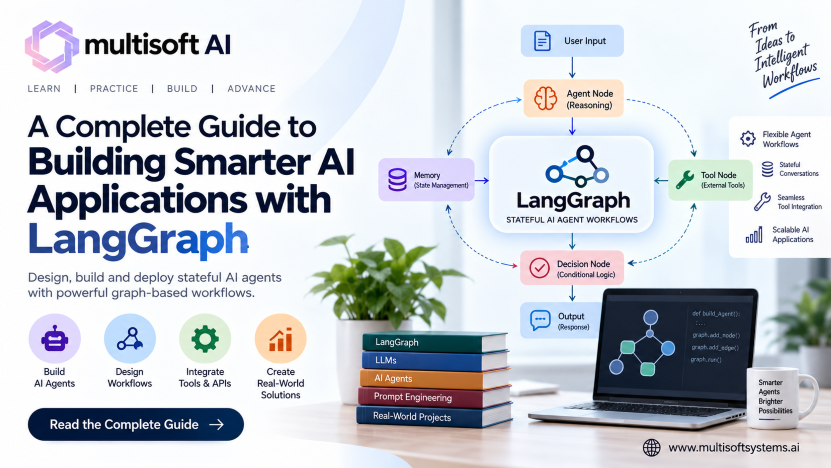
Building Smarter AI Applications with LangGraph: A Complete Guide
Artificial Intelligence is moving beyond simple chatbots and basic question-answering systems. Modern AI applications are expected to understand context, make decisions, use external tools, remember previous interactions and manage complex tasks. As organizations adopt AI agents for customer service, research, automation and enterprise operations, developers need reliable ways to control these increasingly complex workflows. LangGraph is designed for this next stage of AI development. It is a low-level orchestration framework and runtime for building, managing and deploying long-running, stateful AI agents. Its graph-based approach gives developers greater control over how an AI application moves from one step to another. LangGraph supports important capabilities such as durable execution, persistence, memory, streaming and human-in-the-loop workflows. For developers working with Large Language Models (LLMs), LangGraph provides a practical way to create AI applications that can handle branching decisions, repeated steps, tool calls and long-running processes.
Multisoft AI's LangGraph Training is designed to help professionals develop these skills through graph-based workflow development, state management, agent orchestration, tool integration, testing, deployment and real-world projects.
What Is LangGraph?
LangGraph is a framework for building stateful and multi-step AI applications using graph-based workflows. Instead of forcing an AI application to follow one fixed sequence, developers can define different paths that the application can take depending on its current state and decisions.
At the center of a LangGraph application are three important concepts:
- State - Stores the current information about the application.
- Nodes - Perform specific operations or tasks.
- Edges - Define how the workflow moves from one node to another.
These components allow developers to create workflows with sequential steps, conditional branches and loops. For example, an AI customer support application could receive a question, classify it, search a knowledge source, determine whether additional information is needed and then generate a response. Each stage can be represented as a node while edges determine what happens next.
Why Is LangGraph Important for AI Development?
LangGraph helps developers build AI applications that need more control, flexibility and reliable workflow management.
- Manage application state and context
- Support multi-step AI workflows
- Make conditional decisions
- Integrate APIs and external tools
- Maintain memory across interactions
- Coordinate multiple AI agents
- Handle long-running processes
- Support human approval and intervention
- Recover workflows after interruptions
- Build scalable AI and automation solutions
How Does LangGraph Work?
LangGraph works by organizing AI applications into a graph of nodes, edges and state. Nodes perform specific tasks while edges control how the workflow moves between them based on conditions or results. This structure allows AI applications to manage context, make decisions, use tools and handle multi-step workflows more efficiently.
Core Components of LangGraph
State
State stores the information and context required during the AI workflow. It can include user messages, previous results, tool outputs and other data that helps the application understand what has already happened and decide what to do next.
Nodes
Nodes are individual steps or functions within a LangGraph workflow. Each node performs a specific task such as calling an LLM, retrieving information, using a tool, processing data or generating a response.
Edges
Edges define how the workflow moves from one node to another. They can create direct connections or conditional paths based on the result or current state. This allows LangGraph applications to make decisions, repeat steps and follow different workflow paths when required.
Stateful AI Applications
Stateful AI applications can remember and manage information throughout a workflow instead of treating every interaction as a separate request. LangGraph helps maintain context such as previous messages, tool results and workflow progress, making it useful for conversational AI, research assistants, customer support agents and long-running business processes.
Persistence and Durable Execution
Persistence allows LangGraph to save the state and progress of an AI workflow so it can continue from where it stopped. Durable execution helps applications recover from interruptions, failures or long-running processes without restarting the entire workflow. This makes LangGraph useful for reliable AI agents, human approvals, complex automation and production-level applications.
Human-in-the-Loop AI
AI systems should not always make important decisions without human oversight. Some business actions may require approval before execution. LangGraph supports human-in-the-loop workflows where execution can pause and wait for human input. A reviewer can approve an action, modify it or reject it before the workflow continues. For example, an AI agent could prepare an email but require a manager's approval before sending it. Another system could prepare a database operation and wait for authorization before executing the change. This approach provides a balance between AI automation and human control.
LangGraph and AI Agents
AI agents need more than an LLM. They need a way to manage tasks, interact with tools and make decisions. LangGraph provides the orchestration layer that can organize these activities.
An agent workflow might include:
- Receive a user request.
- Understand the objective.
- Decide whether a tool is required.
- Call the appropriate tool.
- Review the returned information.
- Decide whether another action is necessary.
- Generate the final response.
If additional work is required, the graph can route the process back to another node instead of ending the workflow. This makes LangGraph useful for building agents that need to perform multi-step tasks rather than simply respond to a single prompt.
LangGraph and LangChain
LangGraph and LangChain are closely related but serve different purposes. LangChain provides higher-level abstractions and integrations for building applications and agents with models and tools. LangGraph provides lower-level orchestration capabilities for more complex workflows that require state, branching, persistence and control. The official documentation notes that LangChain's agents are built on LangGraph while LangGraph can also be used without LangChain.
A simple way to understand the difference is:
- LangChain - Helps developers work with models, tools and agent abstractions.
- LangGraph - Helps developers control complex agent workflows and execution.
- LangSmith - Supports tracing, evaluation and observability.
Developers can use these technologies together depending on the requirements of their application.
Key Skills Covered in LangGraph Training
LangGraph Training helps learners understand how to design, develop and manage advanced AI workflows using graph-based orchestration. The training focuses on practical skills needed to create stateful AI agents, integrate external tools and develop reliable AI applications.
- Graph-Based Workflow Design
- State Management
- AI Agent Development
- Multi-Agent Orchestration
- Conditional Workflow Routing
- Tool and API Integration
- Memory Management
- RAG Application Development
- Human-in-the-Loop Workflows
- Workflow Testing and Debugging
- AI Application Deployment
- Performance and Security Optimization
Advanced Workflow Design with LangGraph
Advanced workflow design in LangGraph helps developers create AI applications that can handle complex tasks with flexible execution and better control. By combining nodes, edges and state, developers can design workflows that make decisions, repeat actions, run tasks in parallel and involve human approval when required.
- Conditional Workflows
- Parallel Task Execution
- Loops and Iterative Processes
- Dynamic Workflow Routing
- Long-Running AI Processes
- Event-Driven Workflows
- Multi-Agent Workflows
- Human Approval Steps
- State-Based Decision Making
- Complex AI Task Orchestration
LangGraph and External Tools
LangGraph allows AI agents to connect with external tools and systems to perform tasks beyond generating text. Developers can integrate APIs, databases, vector databases and third-party services into workflows, enabling AI agents to retrieve information, process data and take actions based on user requirements.
- API Integration
- Database Connectivity
- Vector Database Integration
- Third-Party Tool Integration
- External Data Retrieval
- AI-Powered Business Automation
- Tool-Based AI Agents
Real-World Applications of LangGraph
AI Customer Support
LangGraph can help structure customer service workflows where an agent understands a request, searches relevant information and generates a response.
Research Assistants
A research assistant can retrieve information, analyze sources and produce structured results through multiple workflow stages.
Document Processing
AI applications can classify documents, extract information, summarize content and route results for review.
Enterprise Knowledge Assistants
Organizations can create assistants that retrieve information from internal knowledge sources while maintaining conversation context.
Multi-Agent Task Automation
Different agents can handle specialized parts of a larger workflow while LangGraph manages communication and execution.
RAG Applications
LangGraph can orchestrate retrieval and generation steps for applications that need to combine LLM capabilities with external knowledge.
Business Process Automation
Organizations can use AI workflows to support processes involving multiple decisions, tools and approval stages.
LangGraph vs Traditional AI Workflows
Traditional AI workflows generally follow a fixed sequence where each step is predefined and the output moves directly to the next stage. LangGraph provides a more flexible graph-based approach that can manage state, make conditional decisions and support loops, tools, memory and human intervention. This makes LangGraph more suitable for complex AI agents and multi-step applications that need dynamic workflow control.
| LangGraph vs Traditional AI Workflows | ||
| Feature | Traditional AI Workflows | LangGraph |
| Workflow Structure | Mostly linear | Graph-based and flexible |
| Execution | Fixed sequence | Dynamic execution |
| State Management | Limited | Strong state management |
| Conditional Routing | Basic | Advanced |
| Memory | Often requires custom setup | Built into workflow design |
| Tool Integration | Separate implementation | Easy to integrate |
| Human-in-the-Loop | Manual integration | Supported |
| Long-Running Tasks | Limited | Supported |
| Multi-Agent Workflows | Less flexible | Well suited |
| Error Recovery | Application dependent | Supports durable execution |
| Workflow Control | Basic | Detailed and customizable |
| AI Applications | Simple use cases | Complex agentic applications |
Benefits of Learning LangGraph
Learning LangGraph can help professionals develop skills for the growing field of agentic AI.
- Build stateful AI applications
- Design graph-based workflows
- Develop intelligent AI agents
- Create multi-agent systems
- Manage workflow state
- Implement conditional routing
- Integrate external tools and APIs
- Build RAG applications
- Add human-in-the-loop controls
- Manage long-running AI workflows
- Improve AI application reliability
- Develop production-oriented Generative AI solutions
These skills can complement knowledge of Python, LangChain, LLMs, RAG, APIs and cloud technologies.
Who Should Learn LangGraph?
- AI Engineers
- Generative AI Developers
- Python Developers
- Machine Learning Engineers
- Data Scientists
- Software Developers
- AI Application Developers
- Solution Architects
- Technical Architects
- Data Engineers
- Cloud Engineers
- Automation Professionals
- MLOps Professionals
- AI Researchers
- Technology Consultants
- IT Professionals Moving into AI
- Students and Technology Enthusiasts
Career Opportunities After Learning LangGraph
LangGraph skills can help professionals explore emerging roles in AI development, Generative AI, agentic AI and intelligent automation. Knowledge of AI agents, workflow orchestration, LLM integration and stateful applications can support career growth in both technical and enterprise AI environments.
- AI Agent Developer - Build and manage intelligent AI agents.
- Generative AI Engineer - Develop LLM-powered applications and AI solutions.
- AI Automation Engineer - Create intelligent workflows for business automation.
- AI Solutions Architect - Design scalable AI application architectures.
- AI Application Developer - Develop applications using LLMs, tools and AI workflows.
- Machine Learning Engineer - Integrate AI models into intelligent applications.
- Multi-Agent Systems Developer - Design and manage collaborative AI agent systems.
- AI Consultant - Help businesses implement AI and automation solutions.
- AI Workflow Developer - Create and optimize complex agentic workflows.
- AI Researcher - Explore new approaches to AI agents and orchestration.
Latest LangGraph Trends in 2026
The development of LangGraph reflects several important trends in the AI industry.
Stateful Agent Systems
Organizations are increasingly interested in AI agents that can maintain context and manage ongoing tasks instead of treating every interaction independently.
Durable AI Workflows
Long-running AI applications need to survive interruptions and failures. Persistence and checkpointing are becoming important parts of reliable agent design.
Human-Controlled Automation
AI agents are becoming more capable but organizations still need control over sensitive actions. Human-in-the-loop workflows allow organizations to combine automation with oversight.
Multi-Agent Applications
Complex business problems can require multiple specialized agents. LangGraph can provide the orchestration layer needed to coordinate these systems.
Production-Ready AI
The industry is moving from AI prototypes toward production applications that require monitoring, testing, security, persistence and performance optimization.
More Flexible Agent Architectures
LangGraph's current direction emphasizes low-level orchestration so developers can combine deterministic logic with agentic behavior rather than relying on one fixed architecture.
Why Choose Multisoft AI for LangGraph Training?
Multisoft AI's LangGraph Training is designed around practical AI application development. The course covers graph-based workflows, state management, agent development, multi-agent architectures, LangChain integration, RAG, external integrations, testing, deployment and real-world projects. The program includes 24+ hours of expert-led training, interactive live masterclasses, practical hands-on learning, project development, certification support, lifetime LMS access and recorded live sessions. Learners can choose from one-to-one training, live online instructor-led learning or customized corporate training. The corporate format can include tailored curriculum, flexible scheduling, real-world case studies and hands-on practice. The practical focus helps learners move from understanding LangGraph concepts to applying them in AI-powered projects.
The Future of LangGraph and Agentic AI
The future of AI is increasingly focused on applications that can reason, remember, use tools and complete tasks. As these systems become more complex, developers need better ways to control their execution. LangGraph is positioned around this challenge by providing orchestration capabilities for stateful and long-running agents. Its current documentation highlights durable execution, persistence, human-in-the-loop workflows, memory and production-oriented deployment as central capabilities. LangGraph v1 also focuses on stability while keeping its core graph APIs and execution model consistent. The release continues to emphasize checkpointing, persistence, streaming and human-in-the-loop capabilities. For developers, this means learning LangGraph is not only about understanding nodes and edges. It is about learning how to design reliable AI systems that can operate across multiple steps while maintaining state and responding to real-world conditions.
Conclusion
LangGraph provides a structured approach to building modern AI applications that require more than simple LLM responses. Its graph-based architecture allows developers to create stateful workflows, manage decisions, connect tools, maintain memory and introduce human oversight. As AI agents become more common in enterprise applications, these capabilities are becoming increasingly important. Developers need to understand not only how to connect an LLM to an application but also how to control what happens before, during and after an AI decision. LangGraph Training can help professionals develop this understanding through practical learning in workflow design, state management, AI agents, multi-agent systems, tool integration, RAG, testing and deployment. Multisoft AI's hands-on approach provides a structured path for learners who want to build practical AI applications and strengthen their Generative AI development skills.
For professionals planning to work in AI engineering, intelligent automation or agentic AI, learning LangGraph can be a valuable step toward building more reliable, flexible and production-ready AI solutions.
About the Author