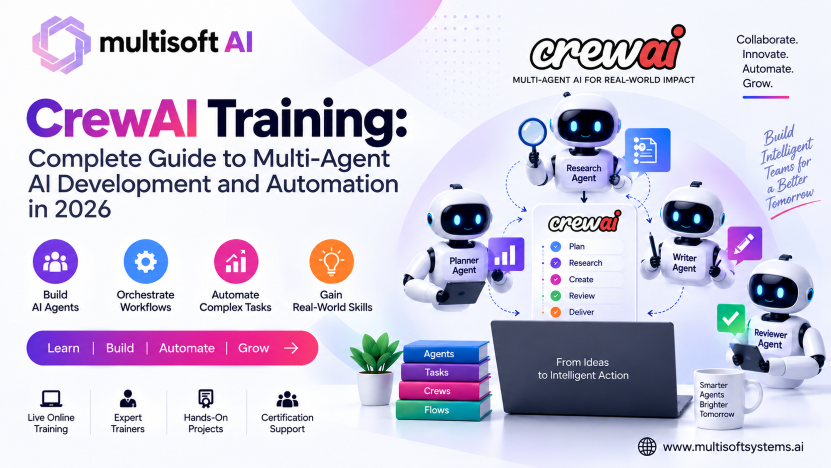
CrewAI Training: Complete Guide to Multi-Agent AI Development and Automation in 2026
Artificial Intelligence is moving into a new stage where AI systems can do more than generate text, answer questions or summarize information. Modern AI applications are increasingly expected to plan tasks, use tools, collaborate with other AI systems and complete multi-step workflows. This shift is driving strong interest in Agentic AI and multi-agent systems. CrewAI has emerged as an important framework for developing collaborative AI agents. It allows developers to create specialized agents that can work together toward a shared objective. The official CrewAI documentation describes the framework around two major concepts: Crews, which coordinate teams of agents and Flows, which provide structured control over AI workflows. This makes CrewAI Training relevant for developers, AI engineers, automation professionals and technology teams looking to build practical multi-agent applications.
Multisoft AI offers CrewAI Training Online Certification Course as part of its AI agent development learning portfolio. The program focuses on helping learners understand how to create intelligent multi-agent systems and apply CrewAI concepts to real-world AI development.
What Is CrewAI?
CrewAI is an open-source Python framework for building and managing multi-agent AI systems where multiple specialized AI agents can collaborate to complete complex tasks. Each agent can be assigned a specific role, goal and responsibility while working together as part of a coordinated workflow. CrewAI helps developers create intelligent applications for research, content creation, data analysis, customer support and business process automation. With features such as agents, tasks, Crews and Flows, it provides a structured approach to developing AI-powered workflows and autonomous applications.
Why Is CrewAI Trending in 2026?
Agentic AI has moved from an experimental concept toward practical enterprise adoption. A 2026 CrewAI survey of 500 senior executives reported that 65% of surveyed enterprises were already using AI agents and 100% planned to expand agentic AI adoption during 2026. The same survey identified security, governance and reliability as major considerations when organizations scale AI agents. Several developments are contributing to the growing interest in CrewAI.
1. Growth of Agentic AI
Organizations increasingly want AI systems that can take action rather than only provide information. Agents can plan tasks, use tools and execute workflows.
2. Multi-Agent Collaboration
Complex business problems may require multiple specialized capabilities. Multi-agent architectures allow different agents to focus on different parts of a workflow.
3. Enterprise Automation
Businesses are exploring AI for research, customer support, operations, marketing, software development and internal knowledge management.
4. Better Workflow Control
Modern CrewAI development is not limited to autonomous agents. Its Flow architecture supports structured, event-driven workflows, state management and conditional execution.
5. Production-Oriented AI
The AI industry is increasingly focused on moving from prototypes to reliable production systems. CrewAI's current ecosystem includes deployment, monitoring, integrations and enterprise-oriented capabilities.
How Does CrewAI Work?
CrewAI works by coordinating multiple AI agents to complete complex tasks. Each agent has a specific role while tasks define what needs to be done. Crews manage agent collaboration and Flows control the overall workflow.
- Agents: Perform specialized roles.
- Tasks: Define specific objectives.
- Crews: Coordinate multiple agents.
- Flows: Manage workflow, events and execution.
CrewAI Crews vs Flows
Understanding the difference between Crews and Flows is an important part of CrewAI Training.
| Feature | Crews | Flows |
| Primary purpose | Agent collaboration | Workflow orchestration |
| Focus | Autonomous teamwork | Structured execution |
| Agents | Multiple specialized agents | Can include agents or Crews |
| Control | More autonomous | More deterministic |
| State management | Supporting capability | Core workflow capability |
| Best suited for | Complex collaborative tasks | Production workflows |
The current CrewAI architecture recommends using both when appropriate. A Flow can manage the overall application while a Crew handles a complex task within one stage of that Flow.
Key Skills Covered in CrewAI Training
A comprehensive CrewAI Online Training program should combine AI fundamentals with practical development skills.
- Agent Design
Learners understand how to define agent roles, goals, responsibilities and capabilities.
- Task Management
Training covers how to create tasks and organize them into meaningful workflows.
- Multi-Agent Orchestration
Participants learn how multiple agents can communicate and collaborate to solve complex problems.
- Tools and Integrations
Agents become more useful when they can interact with external tools. CrewAI supports tool-based agent workflows and integrations with external systems.
- Memory and Knowledge
AI agents may need access to previous interactions or relevant business knowledge. CrewAI's current documentation includes memory and knowledge as part of agent development.
- Structured Outputs
Reliable AI applications often need predictable outputs rather than free-form responses. CrewAI documentation highlights structured outputs using technologies such as Pydantic.
- Workflow Automation
Learners explore how agents can be integrated into broader business processes and automated workflows.
- Testing and Deployment
Modern AI development also requires testing, monitoring, deployment and ongoing optimization.
Real-World Applications of CrewAI
CrewAI can be applied to many business and technical scenarios.
- Market Research
A multi-agent system can divide research into competitor analysis, market trends, customer insights and report preparation.
- Content Marketing
One agent can conduct research while another creates content and another reviews the final output.
- Customer Support
AI agents can classify requests, retrieve information, prepare responses and escalate complex cases.
- Software Development
Different agents can assist with requirements analysis, coding, testing, documentation and code review.
- Business Intelligence
Agents can collect business data, analyze trends and prepare management reports.
- Lead Qualification
A multi-agent workflow can evaluate customer information, classify leads and recommend follow-up actions.
- Document Processing
Agents can extract information, summarize documents, validate data and prepare structured results.
- Enterprise Automation
AI agents can interact with APIs, databases and business applications to support end-to-end processes. The increasing use of AI agents for enterprise automation is one reason multi-agent frameworks are receiving greater attention in 2026. CrewAI's own enterprise research reports that organizations are actively expanding agentic AI across teams and workflows.
CrewAI and Enterprise AI Automation
Enterprise AI requires more than an impressive demonstration. Organizations need systems that can be monitored, controlled and integrated with existing infrastructure. CrewAI's ecosystem increasingly reflects this requirement. Its documentation includes deployment, monitoring, triggers, integrations, team management and observability features for production-oriented workflows. This creates an important learning opportunity for professionals.
Instead of learning only how to create an individual AI agent, professionals can learn how to design complete AI workflows involving:
- Agents
- Crews
- Flows
- APIs
- Databases
- Business applications
- Knowledge sources
- Human approval
- Monitoring
- Security controls
This broader understanding is valuable when developing enterprise-grade AI applications.
CrewAI vs Traditional AI Automation
Traditional AI automation mainly follows predefined rules and fixed workflows. CrewAI uses multiple AI agents that can collaborate, make decisions and handle complex tasks more dynamically. While traditional automation is suitable for repetitive processes, CrewAI is better suited for workflows that require reasoning, coordination and flexible task execution.
Benefits of Learning CrewAI
Learning CrewAI helps professionals understand how to build and manage multi-agent AI systems for complex tasks and business automation. It can strengthen Generative AI skills while providing practical knowledge of agents, workflows and AI orchestration.
- Learn Multi-Agent AI Development
- Build AI-Powered Workflows
- Develop Agent Orchestration Skills
- Work with LLM-Based Applications
- Automate Complex Business Tasks
- Improve Generative AI Expertise
- Create Practical AI Projects
- Prepare for Emerging AI Career Opportunities
- Understand AI Tools and Integrations
- Build Skills for Enterprise AI Automation
Who Should Join CrewAI Training?
- AI Developers
- Generative AI Engineers
- Machine Learning Engineers
- Python Developers
- Software Developers
- Data Scientists
- Automation Engineers
- AI Architects
- Solution Architects
- Data Engineers
- MLOps Professionals
- Cloud Professionals
- Technical Consultants
- Business Automation Professionals
- AI Researchers
- Technology Professionals
Career Opportunities After CrewAI Training
As organizations experiment with and scale AI agents, professionals who understand agent orchestration can explore several career paths.
Potential roles include:
- AI Agent Developer
Design and develop autonomous AI agents for specific business applications.
- Generative AI Engineer
Build applications using LLMs, agents, retrieval systems and automation frameworks.
- AI Automation Engineer
Design intelligent workflows that combine AI agents with business systems.
- Multi-Agent Systems Developer
Develop collaborative agent architectures for complex applications.
- AI Solutions Architect
Design enterprise AI architectures involving models, agents, APIs and data systems.
- AI Consultant
Help organizations identify and implement practical AI automation opportunities. CrewAI knowledge can also complement skills in LangGraph, AutoGen, LangChain, MCP, RAG, vector databases and cloud AI platforms.
Latest CrewAI Trends to Watch in 2026
The development of CrewAI reflects broader trends in agentic AI.
- Production-Ready Agent Systems
Organizations are moving from demonstrations toward reliable AI systems that can operate within business environments.
- AI Agent Observability
As agents become more autonomous, developers need better visibility into decisions, tool calls, errors and workflow execution.
- Human-in-the-Loop AI
Human approval remains important for sensitive or high-impact actions. Modern AI workflows increasingly combine automation with human oversight.
- AI Governance and Security
Security and governance are becoming central concerns as agents gain access to enterprise information and tools. CrewAI's 2026 enterprise research identified security and governance as a leading evaluation factor for organizations.
- Event-Driven AI Workflows
Flows allow AI applications to respond to events and manage multi-step processes using structured execution.
- Enterprise Integrations
Connecting agents with business platforms is becoming increasingly important. Current CrewAI documentation highlights integrations and triggers involving systems such as Gmail, Slack and Salesforce.
- Cost Optimization
As organizations operate larger numbers of agents, reducing unnecessary model calls and improving workflow efficiency will become increasingly important.
Why Choose Multisoft AI for CrewAI Training?
Multisoft AI's CrewAI Training provides a practical learning approach to help participants understand multi-agent AI development, agent orchestration and workflow automation. The training focuses on building a strong foundation in CrewAI concepts while helping learners develop skills that can be applied to real-world AI projects and enterprise automation.
What Is the Future of CrewAI?
The future of CrewAI will be closely connected to the broader evolution of agentic AI. As businesses deploy more autonomous systems, the focus is likely to shift from simply creating agents toward managing complete agent ecosystems. Reliability, observability, security, governance, integration and cost management will become increasingly important. CrewAI's current documentation already reflects this direction through its focus on Crews, Flows, memory, knowledge, guardrails, observability, integrations and production deployment. For developers, this means that learning CrewAI should not be limited to syntax. The most valuable skill is understanding how to design useful AI systems that solve business problems while remaining controllable and maintainable.
Conclusion
CrewAI is becoming an important technology for professionals exploring Agentic AI and multi-agent systems. Its approach allows developers to create specialized AI agents that collaborate on complex tasks while Flows provide structured control over broader application workflows. The growing enterprise interest in agentic AI makes CrewAI Training a relevant learning path for developers, AI engineers, automation specialists and technology professionals. Learning agents, tasks, Crews, Flows, tools, integrations and workflow orchestration can help professionals move from basic Generative AI applications toward more advanced AI systems. In 2026, the AI industry is increasingly focused on turning intelligent agents into useful business systems. Professionals who understand how to design, orchestrate and deploy multi-agent workflows can position themselves for emerging opportunities in AI development and automation.
CrewAI Training by Multisoft AI can provide a structured foundation for exploring this rapidly developing technology and building practical skills for the next generation of AI applications.
About the Author