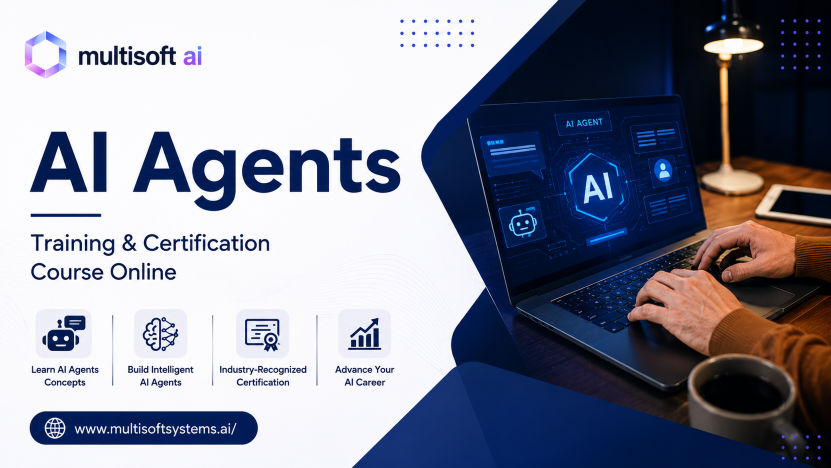
How AI Agents Training Is Shaping the Future of Artificial Intelligence
Introduction
Artificial Intelligence (AI) is evolving at an extraordinary pace, transforming industries by automating complex tasks, enhancing decision-making, and delivering personalized user experiences. Among the latest advancements in this field, AI agents have emerged as a game-changing technology capable of performing autonomous actions, interacting with users, analyzing data, and completing multi-step tasks with minimal human intervention. Unlike traditional AI applications that respond to single prompts, AI agents can reason, plan, learn from context, and execute workflows, making them valuable tools for businesses seeking intelligent automation.
As organizations increasingly adopt AI-driven solutions to improve productivity and streamline operations, the demand for professionals with expertise in AI agent development and deployment is growing rapidly. AI Agents Training equips learners with the knowledge and practical skills required to design, build, and manage intelligent AI agents using modern frameworks, cloud platforms, and large language models. The training combines theoretical concepts with hands-on projects, enabling participants to solve real-world business challenges through AI-powered automation.
Whether you are a beginner exploring Artificial Intelligence, a software developer, a data professional, or an IT specialist looking to upskill, AI Agents Training provides a strong foundation for building a successful career in one of the fastest-growing areas of AI. This article explains how AI Agents Training is shaping the future of Artificial Intelligence, the skills it develops, and why it has become an essential learning path for future-ready professionals.
What Is AI Agents Training?
AI Agents Training is a specialized learning program designed to teach individuals how to build, deploy, and manage intelligent AI agents capable of performing autonomous tasks and solving complex business problems. The training introduces learners to the core concepts of AI agents, including autonomous decision-making, natural language processing, prompt engineering, workflow orchestration, memory management, reasoning capabilities, and integration with external tools and APIs. Participants also gain practical experience using modern AI frameworks, large language models (LLMs), cloud platforms, and automation technologies to develop AI-powered assistants, virtual agents, customer support solutions, and enterprise automation systems. Suitable for beginners and experienced professionals alike, AI Agents Training helps learners understand how intelligent agents operate, interact with users, access knowledge sources, and execute multi-step workflows. By combining conceptual knowledge with hands-on projects, the training prepares professionals for careers in Artificial Intelligence, intelligent automation, software development, and enterprise AI implementation.
How AI Agents Work
AI agents operate by combining large language models, machine learning algorithms, memory, reasoning capabilities, and external tools to perform tasks autonomously. The process begins when a user provides an instruction or query. The AI agent interprets the request using natural language processing, identifies the objective, and develops a plan to accomplish the task. Depending on the complexity of the request, the agent may retrieve information from databases, search internal knowledge repositories, interact with APIs, execute software functions, or communicate with other systems before generating a response. Advanced AI agents can remember previous interactions, adapt their behavior based on context, and refine their actions as new information becomes available. This ability to analyze, reason, make decisions, and complete multi-step workflows enables AI agents to automate business processes, improve customer support, assist software development, optimize operations, and enhance productivity across various industries.
Why AI Agents Are Transforming Artificial Intelligence
AI agents are transforming Artificial Intelligence by moving beyond simple question-and-answer interactions to intelligent, goal-oriented automation. Unlike traditional AI applications that require constant human guidance, AI agents can independently plan tasks, make informed decisions, interact with multiple systems, and execute complex workflows with minimal supervision. This capability enables organizations to automate repetitive processes, improve operational efficiency, accelerate decision-making, and deliver highly personalized user experiences. AI agents are also reshaping industries by supporting customer service, software development, healthcare, finance, education, manufacturing, and enterprise operations through intelligent assistance and real-time problem-solving. As advancements in large language models, cloud computing, and autonomous AI continue to evolve, AI agents are becoming an essential component of digital transformation strategies, enabling businesses to innovate faster, reduce operational costs, and unlock new opportunities for growth and competitive advantage.
Key Features of AI Agents Training
AI Agents Training provides a comprehensive learning experience that combines Artificial Intelligence concepts with practical implementation skills. The program helps learners understand how intelligent agents are designed, developed, and deployed to automate complex tasks and improve business operations. Through instructor-led sessions, hands-on labs, and real-world projects, participants gain practical exposure to the latest AI technologies, frameworks, and enterprise use cases, preparing them for successful careers in the rapidly growing field of intelligent automation.
Key Features
- Comprehensive introduction to AI agents and autonomous AI systems.
- Understanding of Large Language Models (LLMs) and their applications.
- Prompt engineering techniques for intelligent AI interactions.
- Building AI agents for task automation and decision-making.
- Workflow orchestration and multi-step task execution.
- Memory management and contextual reasoning for AI agents.
- Integration with APIs, databases, and third-party applications.
- Retrieval-Augmented Generation (RAG) concepts and implementation.
- Hands-on experience with modern AI frameworks and development tools.
- Practical projects focused on real-world business scenarios.
- Conversational AI and virtual assistant development.
- AI agent testing, monitoring, and performance optimization.
- Responsible AI principles, governance, and ethical considerations.
- Cloud deployment concepts for enterprise AI solutions.
- Exposure to intelligent automation, productivity tools, and AI-powered business applications.
- Industry-focused curriculum aligned with current AI trends.
- Certification-oriented training with practical implementation guidance.
Benefits of AI Agents Training
AI Agents Training equips learners with the knowledge and practical skills needed to design, develop, and deploy intelligent AI-powered solutions that automate complex tasks and improve business efficiency. The training provides a strong foundation in autonomous AI, large language models (LLMs), prompt engineering, workflow automation, Retrieval-Augmented Generation (RAG), and AI agent orchestration. Through hands-on projects and real-world use cases, participants learn how to build AI agents capable of reasoning, interacting with external systems, and making intelligent decisions. As organizations increasingly adopt AI-driven automation, professionals with AI agent expertise are becoming highly sought after across industries. Completing AI Agents Training enhances technical proficiency, strengthens problem-solving abilities, improves career prospects, and prepares learners for advanced roles in Artificial Intelligence, intelligent automation, and enterprise AI development.
Industries Using AI Agents
AI agents are rapidly transforming the way organizations operate by automating workflows, improving decision-making, and delivering intelligent customer experiences. Businesses across diverse industries are adopting AI agents to streamline repetitive tasks, enhance operational efficiency, and support data-driven business strategies. From virtual assistants and customer support bots to intelligent workflow automation and enterprise decision support, AI agents are becoming an essential component of digital transformation initiatives. Industries such as healthcare, banking, finance, retail, manufacturing, education, telecommunications, logistics, insurance, e-commerce, information technology, legal services, travel, hospitality, and government are leveraging AI agents to improve productivity, reduce operational costs, optimize resource utilization, and deliver faster, more personalized services. As AI technologies continue to evolve, the adoption of AI agents is expected to expand across virtually every sector of the global economy.
Career Opportunities
The growing adoption of intelligent automation and generative AI has created significant demand for professionals with expertise in AI agent development and implementation. Organizations are actively seeking individuals who can build autonomous AI systems, integrate AI with enterprise applications, optimize business workflows, and develop intelligent virtual assistants. AI Agents Training prepares learners for a wide range of career opportunities by combining theoretical knowledge with practical experience in AI frameworks, cloud platforms, prompt engineering, and workflow automation. Whether you are a software developer, data professional, cloud engineer, business analyst, or AI enthusiast, mastering AI agents can open the door to exciting and high-paying career paths in the rapidly evolving AI industry.
Career Opportunities
- AI Agent Developer
- Generative AI Engineer
- Artificial Intelligence Engineer
- Machine Learning Engineer
- Prompt Engineer
- AI Solutions Architect
- Intelligent Automation Developer
- AI Application Developer
- Conversational AI Developer
- NLP Engineer
- AI Integration Specialist
- Cloud AI Engineer
- AI Consultant
- Robotics Process Automation (RPA) Developer
- AI Product Manager
- AI Research Engineer
- Data Scientist
- AI Operations (AIOps) Engineer
- Enterprise AI Consultant
- AI Innovation Specialist
Skills You'll Learn
- AI Agent Architecture and Design
- Large Language Models (LLMs)
- Prompt Engineering
- Workflow Automation
- Autonomous AI Development
- Retrieval-Augmented Generation (RAG)
- AI Agent Orchestration
- Natural Language Processing (NLP)
- Memory Management for AI Agents
- Contextual Reasoning
- Function Calling
- API Integration
- Python Programming
- AI Application Development
- Cloud AI Fundamentals
- AI Model Deployment
- Data Processing and Integration
- AI Security and Responsible AI
- Performance Optimization
- Problem-Solving and Analytical Thinking
- Debugging and Testing AI Applications
- Version Control with Git
- Collaboration and Communication Skills
AI Tools & Technologies
- OpenAI GPT Models
- Microsoft Azure OpenAI
- Google Gemini
- Anthropic Claude
- LangChain
- LangGraph
- CrewAI
- AutoGen
- Semantic Kernel
- LlamaIndex
- Hugging Face
- TensorFlow
- PyTorch
- Python
- FastAPI
- Streamlit
- Pinecone
- Weaviate
- ChromaDB
- FAISS
- Docker
- GitHub
- Visual Studio Code
- Jupyter Notebook
- Azure AI Foundry
- Azure AI Studio
- Amazon Bedrock
- Google Vertex AI
- Ollama
- MCP (Model Context Protocol)
Best Practices
Successfully building AI agents requires a combination of technical expertise, careful planning, and responsible AI implementation. Organizations should begin by identifying clear business objectives and selecting use cases where AI agents can deliver measurable value. Developers should design agents with well-defined responsibilities, use effective prompt engineering techniques, integrate trusted data sources through Retrieval-Augmented Generation (RAG), and continuously evaluate agent performance. Strong security controls, data privacy measures, and responsible AI principles are essential to ensure reliable and trustworthy AI solutions. Regular testing, monitoring, user feedback, and continuous optimization help improve the accuracy, efficiency, and scalability of AI agents while supporting long-term business success.
Best Practices
- Define clear business goals before developing AI agents.
- Choose the right AI model for each use case.
- Apply prompt engineering best practices.
- Implement Retrieval-Augmented Generation (RAG) for accurate responses.
- Integrate trusted enterprise data sources.
- Protect sensitive data through strong security measures.
- Follow Responsible AI and ethical AI guidelines.
- Test AI agents extensively before deployment.
- Monitor performance and user interactions continuously.
- Optimize prompts and workflows based on feedback.
- Maintain proper documentation and version control.
- Design scalable AI architectures for future growth.
- Keep AI models and dependencies updated.
- Ensure human oversight for critical business decisions.
- Continuously improve AI agents through learning and refinement.
Future Trends
The future of AI Agents Training is closely connected to the rapid advancement of autonomous Artificial Intelligence, multimodal AI, and intelligent workflow automation. As AI models become more capable of reasoning, planning, and executing complex tasks, AI agents will evolve from simple assistants into highly autonomous digital collaborators capable of managing end-to-end business processes with minimal human intervention. Future developments are expected to include multi-agent collaboration, real-time decision-making, improved memory and contextual understanding, deeper integration with enterprise applications, and seamless interaction across text, voice, images, and video. Organizations will increasingly adopt AI agents for software development, customer service, cybersecurity, healthcare, finance, education, manufacturing, and enterprise operations. As the demand for intelligent automation continues to grow, professionals with expertise in AI agent development, orchestration, and deployment will play a vital role in shaping the next generation of Artificial Intelligence, making AI Agents Training one of the most valuable investments for future-ready careers.
AI Agents Certification Path
Building expertise in AI Agents begins with developing a strong foundation in Artificial Intelligence, machine learning, large language models (LLMs), and prompt engineering. A structured certification path typically starts with learning AI fundamentals, Python programming, and cloud computing concepts before progressing to specialized topics such as AI agent architecture, Retrieval-Augmented Generation (RAG), workflow orchestration, function calling, and enterprise AI integrations. Learners should reinforce their knowledge through hands-on projects, practical labs, and real-world AI agent development using modern frameworks and cloud platforms. Earning industry-recognized certifications in Artificial Intelligence, Generative AI, cloud AI services, and AI agent development demonstrates technical proficiency and enhances professional credibility. Continuous learning is equally important, as AI technologies evolve rapidly with new models, frameworks, and automation capabilities. Following a structured certification path helps professionals build job-ready skills, qualify for advanced AI roles, and stay competitive in the fast-growing field of intelligent automation.
Future Scope
The future of AI Agents is exceptionally promising as organizations increasingly rely on intelligent automation to improve productivity, enhance customer experiences, and accelerate digital transformation. AI agents are evolving beyond simple virtual assistants into autonomous systems capable of reasoning, planning, collaborating, and executing complex business workflows with minimal human intervention. Their adoption is expanding across industries such as healthcare, banking, finance, manufacturing, retail, education, logistics, telecommunications, and cybersecurity, where they are transforming operations through intelligent decision-making and workflow automation. Advancements in multimodal AI, agentic AI, cloud computing, and enterprise integrations will further expand the capabilities of AI agents, creating a strong demand for skilled professionals who can design, deploy, and manage these solutions. As businesses continue to invest in next-generation AI technologies, AI Agents will become a cornerstone of enterprise innovation, making expertise in this domain a valuable and future-proof career choice.
Conclusion
Artificial Intelligence is entering a new era where AI agents are transforming the way businesses automate processes, solve complex problems, and deliver intelligent services. From streamlining enterprise workflows to enhancing customer engagement and supporting data-driven decision-making, AI agents are becoming an essential part of modern digital transformation strategies. As organizations continue to embrace agentic AI and intelligent automation, professionals with expertise in AI agent development, orchestration, and deployment will be in high demand across industries.
If you are ready to build a successful career in this rapidly evolving field, Multisoft AI's AI Agents Training and Certification Program offers the ideal learning pathway. Designed by experienced industry experts, the program combines live instructor-led sessions, hands-on projects, real-world case studies, and certification-focused training to help you master AI agent technologies and practical implementation. Whether you are a beginner, developer, IT professional, or AI enthusiast, enroll with Multisoft AI and gain the skills, confidence, and industry-ready expertise needed to lead the future of Artificial Intelligence.
About the Author