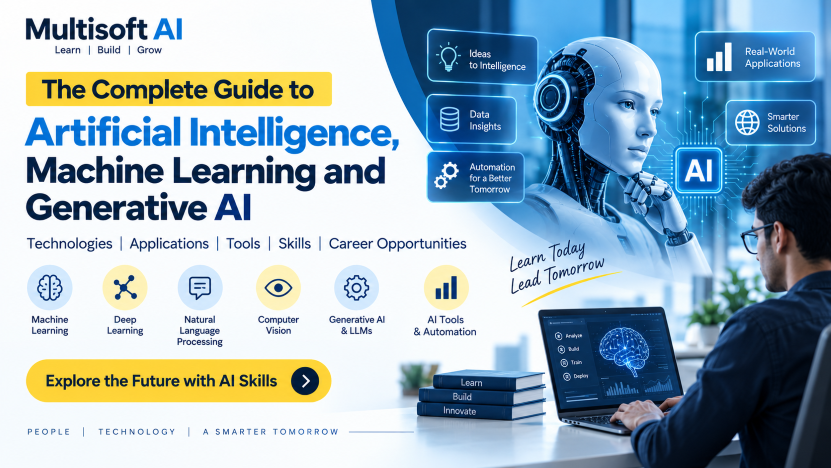
The Complete Guide to Artificial Intelligence, Machine Learning and Generative AI
Artificial Intelligence is transforming the way businesses operate, make decisions and interact with customers. From intelligent automation and predictive analytics to Generative AI, chatbots and computer vision, AI is becoming part of everyday business and technology environments. As organizations continue to adopt AI, professionals need practical knowledge to understand how intelligent systems are designed, developed and applied. Artificial Intelligence Training provides a structured learning path for professionals who want to understand AI fundamentals and explore technologies such as Machine Learning, Deep Learning, Natural Language Processing, Computer Vision and Generative AI. A practical training program can help learners move beyond theory and understand how AI technologies can solve real-world problems.
Multisoft AI's Artificial Intelligence program covers AI fundamentals, machine learning, data preparation, deep learning, NLP, computer vision, Generative AI, AI tools, automation and business applications. The program also includes practical learning, projects and exposure to modern AI platforms.
What Is Artificial Intelligence?
Artificial Intelligence (AI) Training Course Online is a field of technology that enables computer systems to perform tasks that typically require human intelligence. These tasks may include learning from data, recognizing patterns, understanding language, solving problems, making predictions and supporting decisions. AI systems use algorithms, data and computational methods to identify patterns and produce useful results. Depending on the application, an AI system may classify information, predict future outcomes, understand human language, recognize objects in images or generate new content. Today, Artificial Intelligence is used across areas such as healthcare, finance, manufacturing, transportation, education, retail and customer service.
Key Concepts of Artificial Intelligence
- AI fundamentals and terminology
- History and evolution of AI
- Types of Artificial Intelligence
- Narrow AI and General AI
- Machine Learning
- Deep Learning
- Neural Networks
- Natural Language Processing (NLP)
- Computer Vision
- Generative AI
- Large Language Models (LLMs)
- AI automation
- AI-powered applications
- AI tools and platforms
- Responsible and ethical AI
- Real-world AI applications
Why Is Artificial Intelligence Important?
Artificial Intelligence has become an important technology because organizations generate large amounts of data and need efficient ways to analyze and use it. AI can help identify patterns, automate repetitive activities and provide insights that support business decisions. For example, an organization may use AI to predict customer demand, detect unusual transactions, analyze documents, automate customer support or generate business content. AI can also support employees by reducing repetitive tasks and providing intelligent assistance. Instead of replacing every human activity, many organizations use AI to augment human capabilities and allow professionals to focus on tasks that require creativity, judgment and domain expertise. For professionals, learning AI can therefore provide an opportunity to understand both the technical and business sides of digital transformation.
Why Learn Artificial Intelligence?
The growth of AI has created a need for professionals who understand how AI technologies work and how they can be applied effectively. Learning Artificial Intelligence can provide a foundation for exploring machine learning, deep learning, Generative AI and other advanced technologies.
A structured Artificial Intelligence Course can help learners:
- Understand fundamental AI concepts
- Learn different machine learning approaches
- Develop Python skills for AI applications
- Understand neural networks and deep learning
- Explore Natural Language Processing
- Learn computer vision fundamentals
- Understand Generative AI and LLMs
- Explore modern AI tools and platforms
- Understand AI-powered automation
- Work on practical AI projects
- Learn responsible AI concepts
- Prepare for AI-related career opportunities
The goal of training should not be limited to understanding definitions. Learners should also develop the ability to identify business problems where AI can provide practical value.
Understanding Machine Learning
Machine Learning is one of the most important areas of Artificial Intelligence. It enables computer systems to learn patterns from data and use those patterns to make predictions or decisions. Machine learning generally includes approaches such as supervised learning, unsupervised learning and reinforcement learning. Supervised learning uses labeled data to train models for tasks such as classification and regression. For example, a model could be trained to classify customer requests or predict a numerical value. Unsupervised learning works with data where predefined labels are not available. It can be used to identify patterns, groups or relationships within datasets. Reinforcement learning involves learning through interaction, where a system receives feedback based on its actions. Understanding these approaches helps professionals select suitable methods for different AI problems.
Data Preparation for AI
Data plays a central role in Artificial Intelligence. Even advanced AI models can produce poor results when the underlying data is incomplete, inconsistent or poorly prepared. Data preparation may involve collecting relevant information, cleaning datasets, removing duplicates, handling missing values and transforming information into a suitable format.
Important areas include:
- Data collection
- Data cleaning
- Data transformation
- Feature engineering
- Data quality
- Structured data
- Unstructured data
- Data governance
Professionals learning AI should understand that model development is only one part of an AI project. Data preparation and validation can have a significant impact on the quality of the final result.
Deep Learning and Neural Networks
Deep Learning is a specialized area of Machine Learning that uses neural networks with multiple layers to process complex patterns. It is widely associated with applications involving images, language, speech and other large datasets. Neural networks are inspired by the way biological neurons process information, although their actual operation is based on mathematical and computational models.
Important concepts include:
- Neural network architecture
- Input and output layers
- Hidden layers
- Activation functions
- Model training
- Loss functions
- Model evaluation
- Deep learning applications
Learning these concepts helps professionals understand how modern AI systems process complex information.
Natural Language Processing
Natural Language Processing, or NLP, enables computers to work with human language. It is used in applications that need to understand, classify or generate text.
NLP can support applications such as:
- Text classification
- Sentiment analysis
- Language understanding
- Document processing
- Chatbots
- Virtual assistants
- Search systems
- Conversational AI
Professionals learning NLP can understand how AI systems process language and identify patterns in text-based information. NLP has become even more important with the growth of Large Language Models and Generative AI applications.
Computer Vision
Computer Vision enables AI systems to analyze and interpret visual information such as images and video. It has applications across manufacturing, healthcare, retail, security, transportation and other industries.
Important computer vision concepts include:
- Image processing
- Image classification
- Object detection
- Facial recognition concepts
- Visual pattern recognition
- Image-based AI applications
For example, computer vision can help a manufacturing organization identify defects in products or allow an application to identify objects within an image.
Generative AI and Large Language Models
Generative AI is one of the fastest-growing areas within the modern AI ecosystem. Unlike traditional systems that primarily classify or predict information, Generative AI can create new content based on user instructions and available context.
Applications can include:
- Text generation
- Content creation
- Summarization
- Question answering
- Code generation
- Document assistance
- Conversational applications
- Enterprise knowledge assistants
Large Language Models (LLMs) are an important part of modern Generative AI. They can process and generate natural language and can be integrated into a wide range of applications. Artificial Intelligence Training can introduce learners to concepts such as foundation models, LLMs, prompt engineering and enterprise AI applications. This helps professionals understand how modern AI systems are being incorporated into business environments.
Prompt Engineering
Prompt engineering involves creating clear instructions for AI models to produce useful and relevant results. As Generative AI becomes more common, understanding how to communicate effectively with AI models has become a practical skill.
Effective prompts can define:
- The role of the AI system
- The task to be completed
- Relevant context
- Expected response format
- Tone and communication style
- Specific constraints
Professionals can use prompt engineering for content generation, analysis, summarization, research assistance, coding and business workflows.
AI Automation and Business Applications
AI is increasingly being combined with automation technologies to streamline business processes. Instead of manually completing every repetitive activity, organizations can use AI-powered systems to process information and support workflows.
Potential applications include:
- Customer support automation
- Document processing
- Intelligent data analysis
- Lead management
- Workflow automation
- Predictive analytics
- Employee assistance
- Business process optimization
Understanding AI automation can help professionals identify processes where intelligent technologies can reduce manual work and improve efficiency.
Python for Artificial Intelligence
Programming knowledge can be valuable for professionals who want to develop AI applications. Python is widely used in AI and Machine Learning because of its extensive ecosystem of libraries and development tools. A structured program can introduce Python concepts relevant to AI development and help learners understand how programming supports data processing, model development and application building. Python can also be used with AI and Machine Learning frameworks to develop and test intelligent solutions. For professionals without extensive programming experience, learning the fundamentals first can make more advanced AI concepts easier to understand.
AI Tools and Technologies
The AI ecosystem includes a wide range of tools and platforms. Professionals should understand not only individual tools but also how different technologies fit together.
Modern AI learning can include exposure to technologies such as:
- Python
- TensorFlow
- R
- SAS
- AWS AI services
- ChatGPT
- Claude
- Gemini
- Microsoft Copilot
- Machine Learning libraries
- Deep Learning frameworks
- AI development platforms
Learning different tools can help professionals compare approaches and select suitable technologies for particular requirements.
Practical Learning and Projects
Practical experience is an important part of developing AI skills. Reading about AI concepts can provide theoretical knowledge, but working on projects helps learners understand how those concepts are applied.
Projects can involve activities such as:
- Building machine learning models
- Preparing datasets
- Developing AI applications
- Creating NLP solutions
- Exploring computer vision
- Working with Generative AI
- Building intelligent assistants
- Automating business processes
Multisoft AI's Artificial Intelligence program includes practical learning, assignments, projects, case studies and exposure to AI tools and platforms. This practical approach can help learners connect technical concepts with real-world requirements.
Responsible and Ethical Artificial Intelligence
As AI becomes more widely used, responsible development is increasingly important. AI systems can affect decisions, customer experiences and business operations, so organizations need to consider how these systems are designed and deployed.
Responsible AI includes areas such as:
- Data privacy
- Security
- Fairness
- Transparency
- Bias management
- Human oversight
- Responsible data usage
- Model monitoring
Professionals should understand that successful AI implementation is not only about achieving technical performance. It is also about using AI appropriately and responsibly.
Who Should Learn Artificial Intelligence?
Artificial Intelligence training can be useful for professionals from technical and business backgrounds who want to develop AI knowledge.
It can be suitable for:
- AI professionals
- Machine Learning professionals
- Software developers
- Data scientists
- Data analysts
- Business analysts
- Technology professionals
- Automation professionals
- Aspiring AI engineers
- Students interested in AI
- Digital transformation professionals
- Professionals moving into AI-focused roles
Individuals with knowledge of programming, mathematics, statistics and analytical concepts may find it easier to progress through technical AI topics.
Benefits of Artificial Intelligence Training
Learning Artificial Intelligence can provide several professional and technical benefits.
- Build a strong foundation in AI
- Understand Machine Learning concepts
- Learn Deep Learning fundamentals
- Develop Python skills for AI
- Explore NLP technologies
- Understand Computer Vision
- Learn Generative AI concepts
- Explore Large Language Models
- Work with modern AI tools
- Understand AI automation
- Develop practical problem-solving skills
- Gain project-based experience
- Understand responsible AI
- Explore different AI career paths
- Prepare for AI-focused professional opportunities
The combination of technical concepts and practical applications can help learners develop a broader understanding of the AI ecosystem.
Artificial Intelligence Certification
An Artificial Intelligence Certification can provide formal recognition of knowledge gained through structured learning. However, certification is most valuable when supported by practical skills and project experience. A comprehensive program can combine instructor-led sessions, practical assignments, assessments, projects and certification guidance. This approach gives learners an opportunity to validate their understanding while developing hands-on experience. Multisoft AI provides certification as part of its Artificial Intelligence training and offers different learning formats for individuals and organizations.
Artificial Intelligence Training Online
Online training provides flexibility for professionals who want to develop AI skills while continuing their existing work or studies. Artificial Intelligence Training Online can include live instructor-led classes, practical assignments, guided exercises, case studies, project work and recorded sessions. Multisoft AI provides live online instructor-led learning along with practical exercises, projects, learning resources and certification guidance. One-to-one and customized corporate training options are also available. This flexibility can make online AI learning suitable for working professionals, students and organizations with different scheduling requirements.
Career Opportunities in Artificial Intelligence
AI skills can support career opportunities across software development, data science, analytics, automation and digital transformation.
Potential roles include:
- Artificial Intelligence Engineer
- Machine Learning Engineer
- Data Scientist
- Deep Learning Engineer
- NLP Engineer
- Computer Vision Engineer
- AI Application Developer
- AI Solutions Consultant
- AI Automation Specialist
- AI Business Analyst
- AI Solutions Architect
- Generative AI Developer
Career progression depends on technical skills, practical experience, specialization and professional background. Building projects and gaining experience with modern AI technologies can strengthen a professional portfolio.
Why Choose Multisoft AI?
Multisoft AI provides a structured learning environment designed to help learners understand Artificial Intelligence from foundational concepts through advanced applications.
Key highlights include:
- Expert-led AI training
- Practical, hands-on learning
- Real-time projects
- Live online instructor-led sessions
- One-to-one training options
- Customized corporate programs
- Exposure to modern AI tools
- Machine Learning and Deep Learning concepts
- NLP and Computer Vision
- Generative AI and LLM concepts
- AI automation and business applications
- Practice assessments
- Recorded learning sessions
- Lifetime LMS access
- Certification guidance
- Post-training support
The program's broad curriculum allows learners to explore multiple areas of Artificial Intelligence rather than focusing on only one technology.
Conclusion
Artificial Intelligence is becoming a major part of modern technology and business transformation. From Machine Learning and Deep Learning to NLP, Computer Vision, Generative AI and automation, AI technologies are creating new ways to solve problems and improve business operations. Artificial Intelligence Training can help professionals build a structured understanding of these technologies while developing practical skills through exercises, projects and real-world applications. Learning AI is not simply about understanding how models work; it is also about knowing where and how intelligent technologies can provide meaningful value.
Multisoft AI's Artificial Intelligence program brings together foundational concepts, modern AI technologies, practical learning, projects, tools and certification support. For professionals looking to strengthen their AI knowledge or prepare for emerging opportunities, developing these skills can provide a strong foundation for continued growth in the rapidly evolving AI landscape.
About the Author