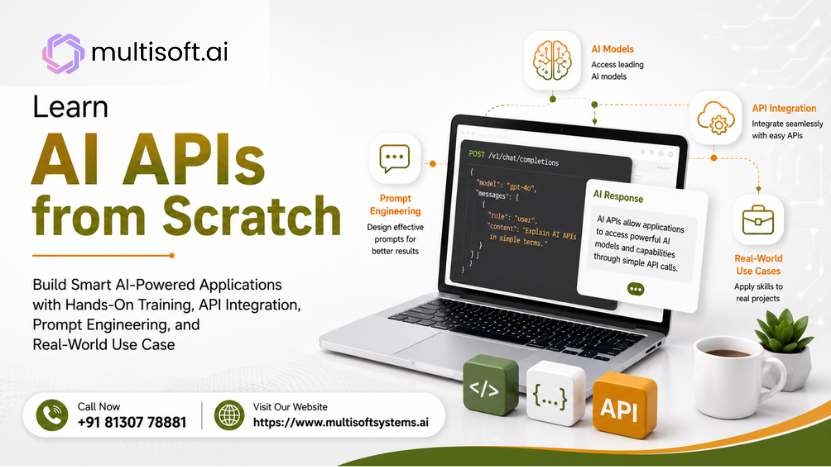
The Ultimate Guide to AI APIs Training: Learn AI Integration from Scratch
Artificial Intelligence (AI) is changing the way businesses build applications, automate tasks, and deliver better customer experiences. One of the easiest ways to use AI without creating complex machine learning models is through AI APIs (Application Programming Interfaces). AI APIs allow developers and businesses to integrate powerful AI capabilities such as natural language processing, image recognition, speech-to-text, text generation, translation, and predictive analytics into their applications with just a few lines of code. Today, organizations across healthcare, finance, e-commerce, education, manufacturing, and customer service rely on AI APIs to improve efficiency and innovation. Learning AI APIs has become an essential skill for software developers, data professionals, cloud engineers, and AI enthusiasts who want to build intelligent applications quickly.
A structured AI APIs Training program helps learners understand API integration, authentication, prompt design, model selection, and real-world implementation using leading AI platforms, preparing them for the rapidly growing AI-driven technology landscape.
What is AI APIs Training?
AI APIs Training is a professional learning program that teaches individuals how to integrate Artificial Intelligence capabilities into applications using pre-built AI APIs (Application Programming Interfaces). Instead of developing AI models from scratch, learners gain hands-on experience in connecting applications with powerful AI services for tasks such as text generation, natural language processing (NLP), image recognition, speech-to-text, translation, chatbots, sentiment analysis, and code generation. The training covers essential concepts including REST APIs, JSON, API authentication, cloud-based AI services, Prompt Engineering, API testing, error handling, and best integration practices. Through practical projects and real-world use cases, participants learn how to build intelligent applications quickly and efficiently using leading AI platforms. AI APIs Training is ideal for software developers, Python programmers, cloud engineers, data professionals, AI enthusiasts, and IT professionals who want to enhance their technical skills and create scalable AI-powered solutions for modern business needs.
AI APIs Fundamentals
AI APIs (Artificial Intelligence Application Programming Interfaces) are ready-to-use interfaces that allow developers to integrate AI capabilities into applications without building AI models from scratch. They enable applications to perform intelligent tasks such as text generation, image recognition, speech processing, language translation, and chat automation by connecting to cloud-based AI services. AI APIs help businesses develop smart applications faster while reducing development time and complexity.
Key Fundamentals of AI APIs
- Connect applications with AI-powered cloud services.
- Use REST APIs and JSON for data exchange.
- Support text, image, audio, and video processing.
- Require API keys or OAuth for secure authentication.
- Easily integrate with web, mobile, and enterprise applications.
- Save time and cost by eliminating the need to build AI models from scratch.
- Widely used in chatbots, virtual assistants, content generation, and automation solutions.
Benefits of AI APIs
Using AI APIs offers numerous advantages for developers, businesses, and organizations.
- Faster AI application development
- No need to build AI models from scratch
- Lower infrastructure and development costs
- Easy integration with existing applications
- Access to continuously updated AI models
- High scalability for enterprise applications
- Faster deployment of AI-powered solutions
- Improved customer experience
- Better automation of repetitive tasks
- Increased business productivity
- Supports cloud-native application development
- Enables rapid prototyping of AI products
- Reduces machine learning complexity
- Improves decision-making with intelligent insights
- Supports multiple programming languages
- Secure authentication and access management
- Real-time AI processing capabilities
- Suitable for startups as well as large enterprises
- Simplifies application modernization
- Helps developers focus on business logic instead of AI infrastructure
How AI APIs Work
AI APIs follow a simple request-and-response model that allows applications to access advanced AI capabilities over the internet. First, a developer creates an account with an AI service provider and obtains an API key, which acts as a secure authentication token. The application then sends an HTTP request to the AI API endpoint, along with the required data such as text, images, audio, or documents. The AI model hosted on the provider's cloud platform processes the input using advanced machine learning algorithms and large language models. After processing, the API returns a structured response, usually in JSON format, containing the generated text, predictions, classifications, or analysis results. Developers can then display this output within websites, mobile apps, enterprise software, chatbots, automation tools, or business workflows. Since the AI processing happens on cloud servers, organizations do not need expensive hardware or deep AI expertise, making AI APIs an efficient and scalable solution for building intelligent applications.
Types of AI APIs
- Natural Language Processing (NLP) APIs
- Large Language Model (LLM) APIs
- Chatbot APIs
- Text Generation APIs
- Image Generation APIs
- Image Recognition APIs
- Computer Vision APIs
- Speech-to-Text APIs
- Text-to-Speech APIs
- Translation APIs
- Sentiment Analysis APIs
- Document Processing APIs
- OCR (Optical Character Recognition) APIs
- Recommendation APIs
- Facial Recognition APIs
- Video Intelligence APIs
- Voice Recognition APIs
- Code Generation APIs
- Predictive Analytics APIs
- Search and Knowledge APIs
Use Cases of AI APIs
AI APIs are transforming industries by enabling businesses to build intelligent applications without investing heavily in AI infrastructure. Their flexibility and ease of integration make them suitable for organizations of all sizes.
1. AI Chatbots
Businesses use AI APIs to develop intelligent chatbots that provide instant customer support, answer frequently asked questions, resolve common issues, and improve customer satisfaction.
2. Content Creation
Marketing teams use AI APIs to generate blogs, social media posts, emails, product descriptions, advertisements, reports, and website content in a fraction of the time.
3. Virtual Assistants
AI-powered virtual assistants help users schedule meetings, answer questions, summarize information, manage tasks, and automate daily activities.
4. Language Translation
Translation APIs enable businesses to communicate with global audiences by converting content into multiple languages while maintaining context and accuracy.
5. Document Processing
Organizations automate document classification, invoice processing, contract analysis, resume screening, and information extraction using AI-powered document intelligence APIs.
6. Image Recognition
Retail, healthcare, manufacturing, and security companies use image recognition APIs to identify objects, classify products, detect defects, and improve operational efficiency.
7. Speech Recognition
Speech-to-text APIs convert spoken language into written text for meeting transcription, voice commands, accessibility applications, and customer service automation.
8. Healthcare Applications
Hospitals and healthcare providers use AI APIs for medical image analysis, clinical documentation, patient communication, disease prediction, and healthcare automation.
9. Financial Services
Banks use AI APIs for fraud detection, risk assessment, customer verification, intelligent document processing, and financial forecasting.
10. Software Development
Developers integrate AI APIs to generate code, debug applications, write documentation, create test cases, and improve software development productivity.
11. E-Commerce
Online retailers use AI APIs for personalized product recommendations, customer support, intelligent search, inventory forecasting, and automated product descriptions.
12. Education
Educational platforms leverage AI APIs to create personalized learning experiences, generate quizzes, summarize study materials, and provide intelligent tutoring.
Required Skills to Learn AI APIs
- Basic programming knowledge (Python, JavaScript, Java, or C#)
- Understanding of REST APIs and HTTP methods
- Knowledge of JSON for data exchange
- API authentication using API keys and OAuth
- Basic understanding of Artificial Intelligence and Machine Learning
- Familiarity with Natural Language Processing (NLP)
- Prompt Engineering skills for Generative AI APIs
- Experience with API testing tools like Postman
- Basic cloud computing knowledge (AWS, Azure, or Google Cloud)
- Error handling and API debugging techniques
- Version control using Git and GitHub
- Problem-solving and logical thinking skills
- Understanding of data privacy and API security best practices
- Ability to build and integrate real-world AI applications
- Willingness to continuously learn new AI tools and technologies
Career Opportunities After Learning AI APIs
The demand for professionals with AI API skills is growing rapidly as businesses adopt Artificial Intelligence to automate processes and build intelligent applications. Learning AI APIs enables you to integrate advanced AI features into software, making you a valuable asset across industries such as IT, healthcare, finance, e-commerce, education, and manufacturing. With practical AI API knowledge, you can pursue rewarding careers in the fast-growing AI and cloud technology ecosystem.
Popular Career Opportunities
- AI Application Developer
- AI API Developer
- Generative AI Engineer
- Full Stack Developer
- Python Developer
- AI Integration Specialist
- Machine Learning Engineer
- Cloud AI Engineer
- Chatbot Developer
- NLP Engineer
- AI Solutions Architect
- Software Engineer
- Automation Engineer
- AI Consultant
- Technical Consultant
- AI Product Developer
- Data Engineer
- Backend Developer
- Digital Transformation Consultant
- Freelance AI Developer
Learning Roadmap for AI APIs
Learning AI APIs is easier when you follow a structured approach. Start with programming fundamentals, understand how APIs work, and gradually move toward integrating AI services into real-world applications.
Step 1: Learn Programming Basics
Build a foundation in Python, JavaScript, Java, or C# to write and integrate API code.
Step 2: Understand REST APIs
Learn HTTP methods, API endpoints, requests, responses, and JSON data formats.
Step 3: Learn AI Fundamentals
Understand the basics of Artificial Intelligence, Machine Learning, NLP, and Generative AI.
Step 4: Practice API Integration
Work with popular AI APIs for text generation, image recognition, speech processing, and chatbots.
Step 5: Master Prompt Engineering
Learn to write effective prompts that improve the quality and accuracy of AI-generated responses.
Step 6: Build Real-World Projects
Create AI-powered applications such as chatbots, document analyzers, content generators, or virtual assistants.
Step 7: Learn Security and Testing
Understand API authentication, error handling, and testing tools like Postman for secure integrations.
Step 8: Earn a Professional Certification
Complete an AI APIs Training course to validate your skills and improve your career opportunities.
Best Practices for Working with AI APIs
Following best practices helps developers build secure, scalable, and efficient AI-powered applications.
- Choose the right AI API based on your project requirements.
- Read the API documentation thoroughly before implementation.
- Protect API keys and never expose them in client-side code.
- Use environment variables for storing sensitive credentials.
- Write clear and well-structured prompts for generative AI APIs.
- Validate user input before sending requests to AI services.
- Handle API errors and exceptions gracefully.
- Implement retry mechanisms for temporary failures.
- Monitor API usage and control operational costs.
- Optimize prompts to reduce unnecessary token consumption.
- Cache frequently requested responses whenever possible.
- Respect API rate limits to avoid service interruptions.
- Test APIs in a development environment before production deployment.
- Keep dependencies and SDKs updated with the latest releases.
- Log requests and responses securely for troubleshooting.
- Regularly review AI-generated outputs for quality and accuracy.
- Follow responsible AI practices and comply with data privacy regulations.
- Continuously monitor new AI models and API updates to improve application performance.
AI APIs Training Course Highlights
A comprehensive AI APIs Training program from Multisoft AI is designed to help learners gain practical experience in integrating Artificial Intelligence into modern applications. The course combines theoretical concepts with hands-on implementation, enabling participants to build intelligent, AI-powered solutions confidently.
Key Course Highlights
- Industry-focused curriculum designed by experienced AI professionals
- Beginner-friendly approach with step-by-step learning
- Hands-on practice using leading AI APIs and cloud platforms
- Real-world projects and practical implementation exercises
- Comprehensive coverage of REST APIs, JSON, and API authentication
- Training on Generative AI APIs, NLP APIs, Computer Vision APIs, and Speech APIs
- Prompt Engineering techniques for better AI interactions
- Integration of AI APIs with web and enterprise applications
- Exposure to AI automation workflows and business use cases
- Practical assignments and coding exercises
- Case studies based on real industry scenarios
- Live instructor-led online training sessions
- Interactive doubt-clearing sessions
- Access to learning resources and recorded sessions
- Industry-recognized training completion certificate
- Guidance from experienced trainers with real-world expertise
- Flexible learning schedule for students and working professionals
- Career-oriented learning with practical implementation focus
- Support for project development and portfolio building
- Skills aligned with current industry requirements and emerging AI technologies
Conclusion
Artificial Intelligence APIs have made it easier than ever for developers and businesses to build intelligent applications without creating complex AI models from scratch. From chatbots and virtual assistants to document processing, image recognition, and content generation, AI APIs are driving innovation across every industry. As organizations continue to adopt AI-powered solutions, professionals with AI API integration skills are becoming highly valuable in the global job market. Learning AI APIs not only strengthens your software development capabilities but also prepares you to work with modern cloud-based AI technologies and generative AI platforms.
A structured AI APIs Training program from Multisoft AI provides the practical knowledge, hands-on experience, and industry-relevant skills needed to confidently integrate AI into real-world applications. Whether you are a student, software developer, IT professional, or technology enthusiast, mastering AI APIs is a smart investment that can accelerate your career and help you stay ahead in the rapidly evolving world of Artificial Intelligence.
About the Author