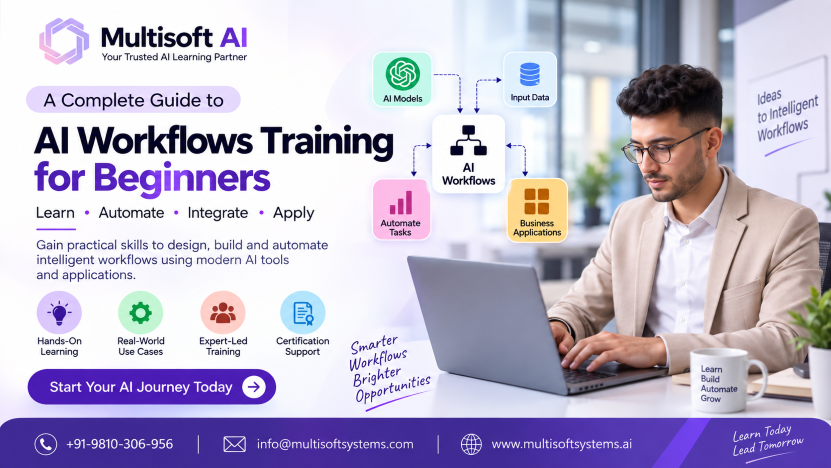
A Complete Guide to AI Workflows Training for Beginners
Artificial Intelligence is changing the way businesses manage daily operations. Organizations are moving beyond simple automation and using AI to connect applications, process information, support decision-making and reduce repetitive manual work. As this shift continues, professionals need practical skills to design workflows that combine AI tools with business processes. AI Workflows Training helps learners understand how to design, automate and optimize AI-powered workflows for real business requirements.
The program offered by Multisoft AI focuses on practical learning, modern AI tools, workflow design, integration, prompt engineering and hands-on projects. It is suitable for professionals, students, business leaders and anyone interested in AI automation.
What Are AI Workflows?
An AI workflow is a structured process that uses artificial intelligence to complete or support a series of connected tasks. Instead of requiring a person to perform every step manually, AI can be integrated into different stages of a workflow. For example, a business may receive a customer email, analyze its content, classify the request, generate a response and update another application. An AI workflow can connect these activities into a coordinated process.
AI workflows can help organizations:
- Reduce repetitive manual tasks
- Improve operational efficiency
- Process information faster
- Connect multiple applications
- Support better decision-making
- Standardize business processes
- Improve productivity
- Create scalable automation solutions
Why AI Workflow Skills Matter
Traditional automation generally follows predefined rules. AI-powered workflows can add capabilities such as natural-language processing, content generation, classification and intelligent decision support. This makes AI workflows useful for business processes where information can vary from one case to another.
Organizations can apply AI workflows across areas such as:
- Marketing
- Customer support
- Human resources
- Finance
- Sales
- IT and helpdesk operations
- Software development
- Business reporting
- Document processing
What You Will Learn in AI Workflows Training
The training is structured into modules covering AI fundamentals, workflow design, AI tools, integration, prompt engineering, real-world applications, practical projects and deployment.
1. Introduction to AI Workflows
This module introduces the concept of AI workflows and explains how artificial intelligence can be incorporated into structured business processes. Learners understand how AI-powered workflows differ from traditional automation and how multiple tasks can be connected to create an end-to-end automated process. The module also covers common business use cases and helps participants identify repetitive activities that can benefit from AI-based automation.
Key topics include:
- AI workflow fundamentals
- Intelligent automation concepts
- AI-powered business processes
- Workflow components and stages
- Common AI workflow use cases
- Identifying automation opportunities
2. AI Fundamentals for Workflows
This section provides the basic AI knowledge needed to understand how intelligent workflows operate. Learners are introduced to Artificial Intelligence, machine learning, generative AI and Large Language Models. The module also introduces prompt engineering and responsible AI concepts so participants can understand how AI tools generate and process information within workflows.
Key topics include:
- Artificial Intelligence fundamentals
- Machine learning basics
- Generative AI
- Large Language Models
- Prompt engineering
- Responsible AI
- AI ethics and practical considerations
3. AI Workflow Design
This module focuses on designing effective AI workflows for practical business requirements. Learners understand how to analyze an existing process, identify suitable tasks for automation and organize different steps into a logical workflow. The training covers process mapping, task sequencing, decision logic and workflow optimization, helping participants design solutions that combine AI capabilities with business applications and processes.
Key topics include:
- Workflow planning and design
- Business process analysis
- Process mapping
- Identifying automation opportunities
- Task sequencing
- Decision-making and conditional logic
- AI tool selection
- Workflow optimization
- Designing end-to-end AI automation solutions
Working with Modern AI Tools
A major part of AI automation involves connecting the right AI tool with the right business requirement. The training introduces several widely used AI platforms, including ChatGPT, Microsoft Copilot, Google Gemini and Claude AI, along with no-code and low-code automation platforms. Learners can understand how different AI tools can contribute to workflow automation and how they can be connected to broader business processes. The goal is not simply to learn individual AI applications. It is to understand how these tools can work together within a structured workflow.
AI Integration and Automation
AI workflows become more valuable when they can connect with the business applications professionals already use. This part of the training explains how AI can interact with existing applications to automate tasks, process information and create connected workflows. Learners are introduced to basic API concepts and understand how AI can be integrated into practical business processes. This knowledge helps professionals move beyond experimenting with individual AI tools and start developing useful automation solutions for everyday business requirements.
The curriculum covers:
- Connecting AI with business applications
- API fundamentals
- Email automation
- Document automation
- Data processing workflows
- Customer support automation
Prompt Engineering for AI Workflows
Prompt engineering plays an important role in creating effective AI-powered workflows because the quality of an AI response depends greatly on how information and instructions are provided. When AI is integrated into an automated process, prompts should be clear, structured and consistent so that the workflow can produce useful results at different stages. This part of the training helps learners understand how to create and refine prompts for practical automation requirements, manage relevant context and use multiple prompts when a workflow involves several steps.
The training covers:
- Effective prompt writing
- Prompt templates
- Context management
- Multi-step prompting
- Prompt optimization
These skills help learners improve the consistency and quality of AI-generated outputs while creating more reliable AI-driven business processes.
Real-World Applications of AI Workflows
One of the strengths of AI workflow automation is its ability to support different business functions.
- Marketing Automation
AI workflows can support content-related processes, campaign activities, research and repetitive marketing tasks.
- HR and Recruitment
AI can be incorporated into workflows for handling documents, organizing information and supporting recruitment-related processes.
- Sales Automation
Sales teams can use workflow automation to streamline repetitive activities and organize customer-related information.
- Finance Process Automation
AI workflows can assist with information processing, document handling and reporting activities.
- IT and Helpdesk Automation
AI can support ticket-related workflows, information retrieval and routine support processes. The Multisoft AI curriculum specifically includes marketing, HR, sales, finance and IT automation examples.
Hands-On AI Workflow Projects
Practical experience is an important part of learning AI automation. The training includes hands-on projects designed around realistic business scenarios.
Learners work on projects such as:
- Building an AI content workflow
- Creating an AI customer support assistant
- Designing a document processing workflow
- Automating business reporting
- Developing an end-to-end AI workflow project
Project-based learning allows participants to connect concepts such as prompts, applications, automation and workflow logic.
Testing, Security and Governance
Creating an AI workflow is only one part of implementation. Organizations also need to consider performance, security, compliance and responsible use.
The course includes best practices for:
- Workflow testing
- Performance monitoring
- Security
- Compliance
- AI governance
- Workflow scaling
These areas are important when moving an AI workflow from experimentation into a business environment.
Who Should Attend AI Workflows Training?
AI automation is becoming relevant across many business and technical functions, making this training suitable for learners from different professional backgrounds. The program is designed for people who want to understand how AI can be used to automate tasks, connect applications and improve business processes. No mandatory prerequisites are required, while basic computer skills and familiarity with AI concepts can be helpful for a smoother learning experience.
The training can be useful for:
- Business professionals
- AI enthusiasts
- Software developers
- IT professionals
- Data analysts
- Project managers
- Business analysts
- Marketing professionals
- Sales professionals
- HR professionals
- Finance professionals
- Operations professionals
- Entrepreneurs
- Startup founders
- Students and graduates
Benefits of Learning AI Workflows
Learning AI workflows helps professionals understand how artificial intelligence can be applied to practical business processes rather than being used only for individual tasks. By developing workflow design, prompt engineering, integration and automation skills, learners can create connected solutions that reduce repetitive work and improve operational efficiency. These skills can also help professionals understand how different AI tools and business applications can work together to support digital transformation.
Key benefits include:
- Understanding AI-powered workflow automation
- Designing end-to-end AI workflows
- Automating repetitive business tasks
- Connecting AI tools with business applications
- Developing practical prompt engineering skills
- Improving workflow efficiency and productivity
- Building hands-on AI automation projects
- Applying AI to real-world business scenarios
- Understanding API-based AI integration
- Supporting digital transformation initiatives
- Developing job-relevant AI automation skills
- Learning responsible AI and workflow best practices
AI Workflows Training Online for Working Professionals
Online instructor-led training provides flexibility for professionals who want to develop AI skills while continuing their existing responsibilities. Multisoft AI provides live online instructor-led sessions, practical assignments, guided exercises, industry-relevant projects and case studies. Weekday and weekend options are available, along with session recordings for revision. The program also offers personalized one-to-one training with flexible scheduling and practical-oriented sessions. Corporate training can be customized according to organizational requirements and delivered virtually or on-site.
Certification and Career Development
Completing the training and assessment provides learners with an AI Workflows Certification from Multisoft AI, according to the course page. The program also includes certification preparation and career guidance.
AI workflow skills can support career development in areas such as:
- AI Automation Specialist
- AI Workflow Developer
- Business Automation Professional
- AI Solutions Specialist
- Automation Consultant
- AI Business Analyst
- Digital Transformation Professional
- AI Operations Specialist
Actual career opportunities will depend on a learner's previous experience, technical background and the requirements of individual organizations.
Why Choose Multisoft AI for AI Workflows Training?
Multisoft AI offers a practical and structured learning experience for professionals who want to develop skills in AI-powered automation. The training combines instructor-led sessions with hands-on exercises, real-world use cases and project-based learning. Participants can learn how to design AI workflows, connect AI tools with business applications, improve prompts and apply automation concepts to practical business requirements.
Key benefits include:
- Instructor-led AI workflow training
- Hands-on practical learning
- Real-world business use cases
- Project-based training approach
- Training with modern AI tools
- Practical prompt engineering exercises
- AI and business application integration
- API fundamentals and automation concepts
- Guided workflow design and implementation
- Interactive sessions and doubt clarification
- Practical assignments and projects
- Flexible online learning options
- Training suitable for beginners and professionals
- Certification after successful course completion
- Focus on job-relevant AI automation skills
The Future of AI-Powered Automation
AI is becoming increasingly connected with everyday business processes. The next stage of automation is not only about completing repetitive tasks but also about using AI to interpret information, generate outputs and support decisions within structured workflows. Professionals who understand workflow design, AI tools, integration and responsible implementation can play an important role in this transformation. AI workflow skills can help organizations move from isolated AI experiments toward connected automation solutions that support measurable business objectives.
Conclusion
AI Workflows Training provides a practical foundation for professionals who want to understand how artificial intelligence can be integrated into business processes. From workflow planning and prompt engineering to AI tools, application integration, automation and hands-on projects, the training covers the key concepts needed to build practical AI-powered workflows. Multisoft AI's program is designed for beginners as well as professionals and includes practical projects, real-world use cases, instructor-led learning and certification. As businesses continue to adopt AI for productivity and digital transformation, the ability to design and optimize intelligent workflows can become an increasingly valuable professional skill.
For learners ready to explore practical AI automation, AI Workflows Training from Multisoft AI offers a structured path to learn, practice and apply AI workflow concepts in real-world business scenarios.
About the Author