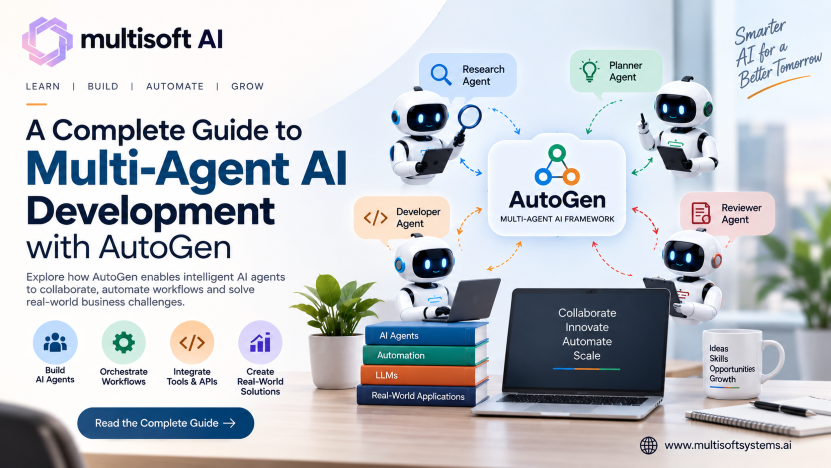
A Complete Guide to Multi-Agent AI Development with AutoGen
Artificial Intelligence is moving beyond traditional chatbots and single-model applications. Businesses are increasingly exploring AI systems that can reason, use tools, collaborate with other agents and automate multi-step tasks. This shift has created growing interest in multi-agent AI development, where several specialized AI agents work together to complete a shared objective. AutoGen is an open-source framework designed to help developers build AI applications using multiple agents that can communicate and collaborate. Microsoft Research describes AutoGen as a framework for creating LLM applications by composing multiple agents that converse with each other to accomplish tasks. As agentic AI continues to develop in 2026, AutoGen skills can be valuable for developers who want to create intelligent workflows, AI assistants and enterprise automation solutions. AutoGen Training provides a structured way to understand agent architecture, LLM integration, multi-agent communication, tool usage, workflow automation, security and deployment.
Multisoft AI's AutoGen Training is designed for professionals and aspiring AI developers who want practical knowledge of building intelligent and collaborative AI applications. The course combines concepts, hands-on labs and real-world projects to help learners develop AI agent solutions.
What Is AutoGen?
AutoGen is an open-source framework for building AI agents and multi-agent systems with Large Language Models (LLMs). It allows developers to create customizable agents that can communicate with one another and work with humans or external tools. The framework was introduced by Microsoft Research to simplify the development of complex LLM-based workflows. Its approach allows developers to define specialized agents and establish interaction patterns between them rather than putting every responsibility into one AI system.
A simple multi-agent application could include:
- A Research Agent that gathers information
- A Data Agent that analyzes information
- A Developer Agent that writes code
- A Reviewer Agent that checks results
- A Human Agent that provides approval when required
Why Is AutoGen Important in 2026?
Agentic AI is becoming an important area of Generative AI development. Businesses are looking for systems that can perform more than generating responses. They want AI applications that can plan activities, interact with tools, collaborate with other systems and support business processes. AutoGen is relevant to this trend because its architecture focuses on agent collaboration and workflow orchestration.
Microsoft Research's AutoGen project has evolved toward a more extensible architecture. AutoGen v0.4 introduced a layered framework with a Core layer, AgentChat layer and extensions designed to support scalable and robust agentic applications. It also introduced cross-language interoperability between Python and .NET.
Key reasons to learn AutoGen include:
- Growing adoption of agentic AI
- Increasing demand for multi-agent applications
- Expansion of LLM-powered automation
- Need for intelligent workflow orchestration
- Integration of AI with tools and APIs
- Growing enterprise interest in AI automation
- Demand for practical Generative AI engineering skills
How Does AutoGen Work?
AutoGen works by connecting multiple AI agents that communicate and collaborate to complete complex tasks. Developers can assign different roles to agents then define how they interact, use tools and process information. An AutoGen workflow can combine LLMs, human input and external tools to plan tasks, perform actions and evaluate results, making it suitable for building intelligent multi-agent applications and automated workflows.
Key Components of AutoGen
- AI Agents
Agents are the core building blocks of AutoGen applications. An agent can be configured with a particular role, behavior and objective. Multisoft AI's training covers assistant agents, user proxy agents, agent behavior configuration, memory and context management and agent lifecycle management.
- Multi-Agent Communication
Agents can communicate with each other to exchange information and coordinate tasks. This makes it possible to create collaborative workflows where different agents perform different responsibilities.
- Group Chat
Group chat patterns allow multiple agents to participate in a shared workflow. This can be useful when a problem requires several specialized perspectives.
- Human-in-the-Loop
Not every AI decision should be completely autonomous. Human-in-the-loop systems allow people to review or approve specific actions. This is especially useful for enterprise applications where accuracy, security and business controls are important.
- Tools and APIs
AI agents become more useful when they can interact with external systems. AutoGen applications can incorporate function calling, APIs, databases and external tools.
- LLM Integration
AutoGen applications can connect with Large Language Models and use model configuration and prompt engineering to control agent behavior.
AutoGen Training Curriculum
A comprehensive AutoGen Training Course should cover both foundational concepts and practical application development. Multisoft AI's published curriculum is structured across 10 modules. It begins with AutoGen fundamentals and continues through Python, LLMs, AI agents, multi-agent collaboration, tool integration, advanced development, security, enterprise applications and a capstone project.
Module 1: Introduction to AutoGen
Learners understand:
- AutoGen framework
- AI agents
- Multi-agent systems
- AutoGen architecture
- Installation and environment setup
- AutoGen ecosystem and use cases
Module 2: Python Fundamentals
Python is important for AutoGen development. The training covers Python essentials, virtual environments, APIs, JSON processing, error handling and debugging.
Module 3: Working With LLMs
This section introduces:
- LLM fundamentals
- OpenAI integration
- Azure OpenAI integration
- Model configuration
- Prompt engineering
- Token management
- Cost optimization
Module 4: Building AI Agents
Participants learn how to create assistant agents and user proxy agents. They also explore agent behavior, memory, context management and lifecycle management.
Module 5: Multi-Agent Collaboration
This module focuses on agent-to-agent communication, group chat, task planning, delegation, human-in-the-loop workflows and multi-agent decision-making.
Module 6: Tool Integration and Automation
Learners explore function calling, API integration, database connectivity, external tools and workflow automation.
Module 7: Advanced AutoGen Development
Advanced topics include custom agent development, agent orchestration, event-driven workflows, state management and performance optimization.
Module 8: Debugging, Monitoring and Security
This area focuses on logging, debugging, monitoring agent performance, exception handling, security and responsible AI.
Module 9: Enterprise AI Applications
Learners explore practical applications such as customer support, document processing, research assistants, software development and business process automation.
Module 10: Capstone Project
The course concludes with an end-to-end project where learners design and build a multi-agent AI solution, test AI agents, evaluate performance and present their project.
AutoGen and Multi-Agent AI Development
AutoGen supports multi-agent AI development by allowing different AI agents to collaborate on complex tasks. Instead of depending on a single AI model, developers can create specialized agents for research, coding, analysis, planning or review and define how they communicate and work together. This approach helps create flexible AI workflows that can combine LLMs, external tools and human input to automate multi-step processes and develop intelligent AI applications.
AutoGen vs Traditional AI Automation
Traditional automation usually follows predefined rules and fixed workflows. AutoGen enables a more flexible approach where AI agents can collaborate and respond to changing task requirements.
| Traditional Automation | AutoGen-Based Automation |
| Rule-based workflows | Agent-based workflows |
| Fixed process | Flexible collaboration |
| Limited decision-making | LLM-supported reasoning |
| Predefined actions | Tool-based agent actions |
| Usually single workflow | Multiple collaborating agents |
| Less adaptable | More adaptable |
| Human intervention may be manual | Human-in-the-loop can be integrated |
This does not mean traditional automation is no longer useful. In many enterprise environments, the strongest solutions combine deterministic automation with AI agents.
Real-World Applications of AutoGen
AutoGen can be applied to different AI and business scenarios.
- Customer Support
Multiple agents can help classify customer requests, retrieve information and prepare responses. A human agent can review sensitive cases before a response is delivered.
- Software Development
AI agents can support requirements analysis, coding, testing, debugging and code review.
- Research Automation
Research agents can collect information while analysis agents organize findings and reporting agents prepare structured results.
- Data Analysis
Agents can process datasets, identify patterns and prepare reports based on business requirements.
- Document Processing
AI workflows can extract information from documents, summarize content and organize results.
- Business Process Automation
Multi-agent systems can support repetitive business workflows that require several stages of reasoning and interaction.
- Enterprise Knowledge Assistants
AI agents can help users retrieve and process organizational knowledge from connected sources. Multisoft AI specifically highlights customer support, software development, data analysis, research automation and enterprise AI solutions as applications covered by its AutoGen training.
Benefits of Learning AutoGen
- Learn Multi-Agent AI Development
- Build Intelligent AI Applications
- Develop AI Agent Orchestration Skills
- Master LLM Integration
- Automate Complex Workflows
- Work with AI Tools and APIs
- Strengthen Generative AI Skills
- Create Real-World AI Projects
- Understand Human-in-the-Loop AI
- Improve AI Automation Capabilities
- Develop Enterprise AI Solutions
- Prepare for Emerging AI Career Opportunities
Who Should Join AutoGen Training?
- AI/ML Engineers
- Generative AI Developers
- Python Developers
- Software Engineers
- Data Scientists
- Data Engineers
- Automation Engineers
- RPA Professionals
- Solution Architects
- Technical Consultants
- Cloud and AI Solution Developers
- DevOps Engineers
- IT Professionals
- AI Researchers
- Innovation Teams
- Students and Graduates
- Technology Professionals
- Business Professionals interested in AI automation
The Multisoft AI course recommends a basic understanding of Python and familiarity with Generative AI or LLMs. Knowledge of APIs and Git is beneficial but not mandatory.
Career Opportunities After AutoGen Training
AutoGen Training can help professionals develop practical skills in multi-agent AI development, LLM integration and intelligent workflow automation. These skills can support career opportunities in Generative AI, AI engineering and enterprise automation as organizations increasingly explore AI agents for complex business processes.
- AI Agent Developer - Develop and manage intelligent AI agents.
- Generative AI Engineer - Build LLM-powered applications and solutions.
- Multi-Agent Systems Developer - Design collaborative AI agent workflows.
- AI Automation Engineer - Create AI-driven business process automation.
- AI Solutions Architect - Design scalable enterprise AI architectures.
- Machine Learning Engineer - Apply AI and ML technologies to intelligent applications.
- AI Consultant - Help organizations identify and implement AI automation opportunities.
- AI Application Developer - Build practical applications using LLMs, agents and external tools.
- AI Researcher - Explore new approaches to agentic AI and multi-agent systems.
- Enterprise AI Specialist - Support organizations in implementing AI-powered solutions.
Latest AutoGen Trends in 2026
- Event-Driven Agentic AI
Modern agentic systems are moving toward event-driven architectures that can respond to events and execute tasks dynamically. AutoGen v0.4 introduced a core foundation for event-driven agentic systems.
- Cross-Language Agent Development
AutoGen v0.4 introduced interoperability between agents developed in Python and .NET with additional language support under development.
- Human-Centered AI
AI agents are increasingly being designed to work alongside humans rather than operate without oversight. Microsoft's research around Magentic-UI also reflects interest in human-centered agentic systems.
- Low-Code AI Development
AutoGen Studio was introduced as a low-code interface for building and debugging multi-agent workflows. Microsoft Research described it as a tool designed to make multi-agent application development more accessible.
- Responsible AI and Governance
As AI agents become capable of performing more actions, security, monitoring, governance and human oversight are becoming increasingly important for production applications.
Why Choose Multisoft AI for AutoGen Training?
Multisoft AI's AutoGen Training combines instructor-led learning with practical development. The published program includes 24+ hours of expert-led training, interactive live masterclasses, hands-on learning, AI application development, practice assessments, lifetime LMS access and recorded sessions. The training also provides different learning formats including one-to-one training, live online instructor-led sessions and customized corporate training. Participants can choose flexible weekday or weekend options while organizations can request a curriculum tailored to their business requirements. The focus on practical labs and a capstone project can help learners connect AutoGen concepts with real-world AI development.
The Future of AutoGen and Multi-Agent AI
The future of AI development is increasingly moving toward systems that can perform tasks rather than simply generate responses. Multi-agent architectures can support this transition by dividing complex objectives into specialized responsibilities. AutoGen's evolution toward extensibility, event-driven architecture, cross-language interoperability and agent development tools demonstrates the broader direction of the framework. However, successful AI agent development will require more than creating autonomous agents. Developers will also need to understand security, evaluation, monitoring, cost management, human oversight and responsible AI practices. Professionals who combine AutoGen knowledge with strong Python, LLM, API and AI engineering skills can be better prepared to develop practical agentic applications.
Conclusion
AutoGen Training offers a practical path for professionals who want to understand multi-agent AI development and intelligent workflow automation. AutoGen enables developers to create customizable agents that can communicate, collaborate, use tools and work with humans to complete complex tasks. From AI agents and LLM integration to multi-agent communication, API connectivity, automation, debugging, security and enterprise applications, the skills covered in AutoGen development can support a wide range of modern AI projects. As organizations continue exploring agentic AI in 2026, understanding how to design and manage collaborative AI systems can become an important professional advantage.
With hands-on learning and real-world projects, Multisoft AI's AutoGen Training can help learners develop the technical foundation needed to build intelligent AI-powered applications and prepare for the evolving field of Generative AI and automation.
About the Author