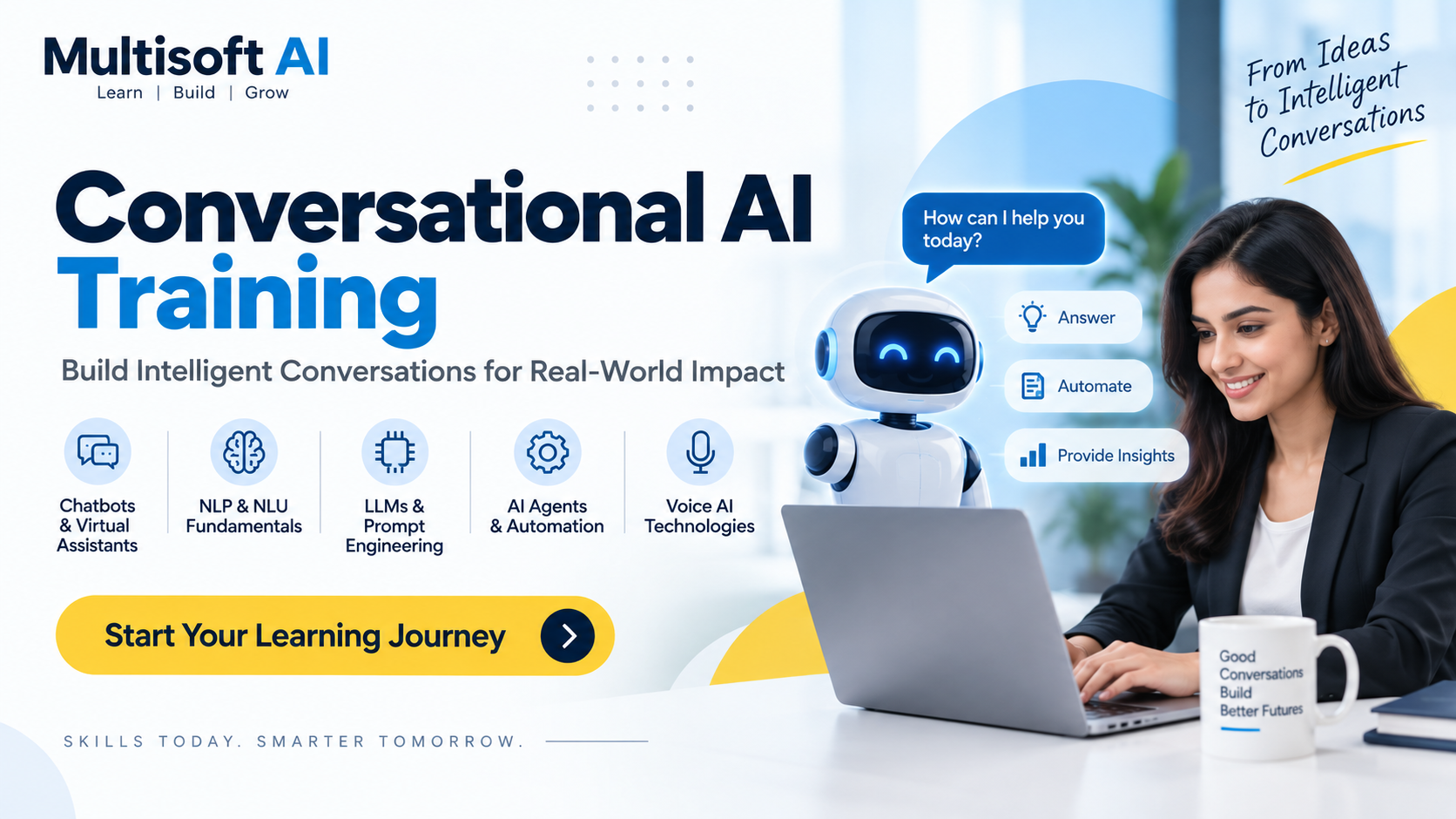
Conversational AI Training: Skills, Technologies and Career Opportunities
Artificial Intelligence is changing the way people communicate with digital systems. Instead of relying only on menus, forms or fixed commands, users can now interact with applications through natural language. From customer support chatbots to virtual assistants and voice-enabled services, intelligent conversations are becoming an important part of modern digital experiences. Conversational AI Training helps professionals understand how these systems are designed, developed, integrated and optimized. The learning journey can cover Natural Language Processing (NLP), Natural Language Understanding (NLU), Large Language Models (LLMs), prompt engineering, dialogue management, chatbots, AI agents, Retrieval-Augmented Generation (RAG), voice technologies and enterprise integrations.
Multisoft AI's program is designed around these technologies and includes practical learning focused on building and deploying AI-powered conversational applications. The curriculum covers tools and frameworks such as Python, TensorFlow, Rasa and Dialogflow while also introducing modern LLM-based conversational systems.
What Is Conversational AI?
Conversational AI refers to technologies that enable computers and applications to communicate with people using natural language through text or voice. It combines technologies such as Natural Language Processing (NLP), Natural Language Understanding (NLU), machine learning and Large Language Models (LLMs) to understand user requests, identify intent, maintain context and generate relevant responses. Conversational AI is commonly used in chatbots, virtual assistants, customer-support systems, voice assistants and enterprise AI applications.
Key Components of Conversational AI
- Natural Language Processing (NLP)
- Natural Language Understanding (NLU)
- Intent recognition
- Entity extraction
- Large Language Models (LLMs)
- Context and conversation management
- Dialogue management
- Response generation
- Chatbot and virtual assistant technologies
- Speech recognition and voice AI
- Knowledge-base integration
- AI agents and workflow automation
Why Is Conversational AI Important for Businesses?
Conversational AI helps businesses improve how they interact with customers, employees and other users through intelligent text and voice-based communication. It can automate routine queries, provide faster responses and support users across different channels. By connecting conversational systems with business applications and knowledge sources, organizations can also streamline processes and provide more personalized assistance. This can reduce repetitive workloads, improve customer experience and support greater operational efficiency while allowing employees to focus on more complex tasks.
How Does Conversational AI Work?
Conversational AI works by combining natural language technologies, AI models and conversation management to understand user messages and generate relevant responses. When a user sends a text or voice request, the system processes the input to identify its meaning, intent and important information. It then uses an AI model, knowledge source or connected application to determine an appropriate response. Conversation history can help maintain context across multiple interactions, while APIs and business systems can enable the AI to perform specific tasks. The response is then delivered to the user through a chatbot, virtual assistant or voice-based interface.
Natural Language Processing and Understanding
Natural Language Processing (NLP) and Natural Language Understanding (NLU) are fundamental technologies in Conversational AI. NLP enables computers to process and work with human language, while NLU focuses on understanding the meaning, intent and context behind user messages. Together, they help conversational systems interpret questions, identify relevant information and provide appropriate responses. These technologies are widely used in chatbots, virtual assistants, customer-support applications and other AI-powered communication systems.
Important Concepts
- Text processing
- Tokenization
- Intent recognition
- Entity extraction
- Natural Language Understanding (NLU)
- Context analysis
- Language classification
- Sentiment analysis
- Speech-to-text processing
- Semantic understanding
- Dialogue management
- Context and conversation management
- Response generation
Large Language Models in Conversational AI
Large Language Models have significantly expanded the capabilities of conversational systems. Modern LLMs can understand natural language, generate responses, summarize information and maintain conversational context. Multisoft AI's curriculum introduces foundation models and provides an overview of GPT, Claude, Gemini and Llama, along with their capabilities and limitations. It also covers context management and conversational intelligence. LLMs can be used to create more flexible conversational experiences, but they also introduce challenges. Developers need to consider response accuracy, context limitations, hallucinations, data privacy and appropriate model usage. This makes evaluation and responsible implementation just as important as model selection.
Prompt Engineering for Conversational Systems
Prompt engineering involves designing instructions that guide an AI model toward useful and consistent outputs.
In conversational applications, prompts can define:
- The role of the AI assistant
- Response style
- Available context
- Task requirements
- Conversation rules
- Output format
- Safety instructions
Multisoft AI's program covers role-based prompting, contextual prompt design, multi-turn conversations, conversation memory and response optimization. Good prompt design can help improve the quality of interactions, especially when the system needs to follow a particular business communication style.
Designing Better Conversations
Technology alone does not guarantee a good conversational experience. The conversation itself needs to be designed around the user's goals.
Conversation design involves planning:
- User journeys
- Conversation flows
- Dialogue paths
- Questions and responses
- Error handling
- Escalation processes
- Confirmation messages
- User experience
A conversational application should make it clear what users can ask and what the system can do. When the system cannot complete a request, it should provide a useful alternative instead of creating confusion. Multisoft AI covers conversation flows, dialogue management, UX design, error handling and human-like interaction design.
Chatbot Development
Chatbots remain one of the most common applications of Conversational AI. They can be used on websites, applications, customer-support platforms and other digital channels.
A chatbot can be:
- Rule-based
- AI-powered
- Knowledge-based
- FAQ-focused
- Enterprise-oriented
Rule-based chatbots work well when the conversation is predictable. AI-powered systems can handle broader language variations and more complex requests. The right architecture depends on the business objective, available data, user expectations and level of automation required.
Virtual Assistants and AI Agents
Virtual assistants are designed to help users complete tasks, find information or interact with services. AI agents can extend these capabilities by performing tasks using connected tools and systems. For example, an enterprise assistant could understand an employee's request, retrieve relevant information and guide the user through a business process. Multisoft AI's training covers virtual assistant concepts, AI agents, task-oriented assistants, personal productivity assistants, enterprise AI assistants and agent-based conversations. This makes conversational systems increasingly useful beyond simple question-answering applications.
Retrieval-Augmented Generation for Conversational AI
One challenge with general-purpose AI models is that they may not have access to current or organization-specific information. Retrieval-Augmented Generation, or RAG, provides an approach for connecting AI models with external knowledge. A RAG-based conversational system can retrieve relevant information from a knowledge source before generating a response.
Important concepts include:
- Knowledge-base integration
- Embeddings
- Vector databases
- Semantic search
- Context retrieval
- Enterprise knowledge assistants
Multisoft AI includes RAG, semantic search, embeddings, vector databases and enterprise knowledge assistants in its Conversational AI curriculum. This can be especially useful for organizations that want conversational applications to work with internal documentation, policies, product information or other business knowledge.
Voice AI and Speech Technologies
Voice AI and speech technologies enable conversational systems to communicate with users through spoken language instead of relying only on text. These technologies typically combine speech recognition, Natural Language Processing (NLP), AI models and text-to-speech capabilities to understand spoken requests and provide natural-sounding responses. They are widely used in voice assistants, customer service systems, automated call handling and hands-free applications. Learning voice AI helps professionals understand how speech is converted into meaningful data, processed by AI and transformed back into an appropriate spoken response.
Integrating Conversational AI with Business Systems
A conversational assistant becomes more useful when it can interact with business applications.
API integrations can connect conversational systems with:
- CRM platforms
- Customer support systems
- Enterprise applications
- Databases
- Workflow automation tools
- Business information systems
For example, a customer-support assistant could retrieve information from a CRM before responding to a customer. An internal assistant could connect with enterprise systems to help employees access relevant information. Multisoft AI includes AI APIs, CRM integration, customer-support platforms, enterprise system connectivity and workflow automation in its integration module.
Evaluating Conversational AI Performance
A conversational system needs continuous evaluation. A chatbot that produces technically correct responses may still provide a poor user experience if it is slow, unclear or unable to maintain context.
Evaluation can consider:
- Intent recognition accuracy
- Response relevance
- Context handling
- Conversation completion rate
- User experience
- Response consistency
- Error frequency
- Escalation effectiveness
Testing should include normal interactions as well as unexpected questions and edge cases.
The Multisoft AI curriculum specifically includes chatbot performance evaluation and conversational accuracy optimization.
Ethical and Responsible Conversational AI
Responsible AI is an important part of conversational application development. Systems that communicate with users should be designed with privacy, fairness, transparency and security in mind.
Professionals should consider:
- Data privacy
- Secure data handling
- Responsible AI practices
- Bias
- User transparency
- Appropriate human oversight
- Safe escalation mechanisms
Multisoft AI's program includes ethical AI design principles and responsible AI practices for conversational systems. Responsible design can help organizations build conversational experiences that are useful while maintaining appropriate safeguards.
Who Should Learn Conversational AI?
- AI and Machine Learning Engineers
- NLP Professionals
- Software Developers
- Chatbot Developers
- Data Scientists
- AI Application Developers
- Automation Engineers
- Business Analysts
- Solution Architects
- UI/UX Designers
- IT Professionals
- Digital Transformation Professionals
- Product Managers
- Customer Experience Professionals
- Generative AI Enthusiasts
- Students and Fresh Graduates
- Professionals looking to build AI-powered conversational applications
Skills Covered in Conversational AI Training
A structured Conversational AI Training Online program can help learners develop practical knowledge in:
- Conversational AI fundamentals
- NLP and NLU
- Intent recognition
- Entity extraction
- LLMs
- Prompt engineering
- Multi-turn conversations
- Conversation memory
- Dialogue management
- Chatbot development
- Virtual assistants
- AI agents
- RAG
- Embeddings and vector databases
- API integration
- CRM integration
- Voice AI
- Speech technologies
- Workflow automation
- Conversational analytics
- Responsible AI
These areas closely reflect the modules and learning objectives published on Multisoft AI's Conversational AI training page.
Benefits of Learning Conversational AI
- Develop practical Conversational AI skills
- Understand NLP and NLU fundamentals
- Learn chatbot development
- Build intelligent virtual assistants
- Work with Large Language Models (LLMs)
- Develop effective prompts for AI applications
- Learn multi-turn conversation and context management
- Understand AI agent development
- Work with RAG and enterprise knowledge systems
- Learn API and CRM integration
- Explore voice AI and speech technologies
- Improve conversational experience design skills
- Understand AI workflow automation
- Develop responsible AI awareness
- Prepare for emerging AI career opportunities
Conversational AI Certification
A Conversational AI Certification can provide formal recognition of knowledge gained through structured training. However, certification is most useful when supported by practical skills and project experience. Multisoft AI's program includes a globally recognized certification, 20+ hours of expert-led training, interactive live masterclasses, practical hands-on learning, practice assessments, lifetime LMS access, recorded live sessions and the opportunity to build an AI-powered application. Learners can choose different formats based on their requirements. These include one-to-one training, live online instructor-led sessions and customized corporate training.
Learning Through a Conversational AI Online Course
Online learning can be useful for professionals who want to develop AI skills while continuing their existing work or studies. Multisoft AI provides live instructor-led virtual sessions with real-time interaction, practical assignments, guided exercises, projects, case studies, recordings and certification guidance. Weekday, weekend and customized scheduling options are available. One-to-one learning provides personalized sessions and flexible scheduling, while corporate programs can be customized around business requirements. This flexibility allows learners and organizations to select a training format that matches their schedules and learning objectives.
Career Opportunities in Conversational AI
- Conversational AI Developer
- AI Engineer
- NLP Engineer
- Chatbot Developer
- AI Application Developer
- Machine Learning Engineer
- AI Solutions Consultant
- Conversational UX Designer
- Virtual Assistant Developer
- AI Automation Specialist
- AI Solutions Architect
- Digital Transformation Specialist
- Conversational AI Specialist
- Voice AI Developer
- Generative AI Developer
Why Choose Multisoft AI?
Multisoft AI's Conversational AI program combines foundational concepts with practical implementation. The curriculum progresses from NLP and conversational architecture to LLMs, prompt engineering, dialogue management, chatbots, AI agents, RAG, enterprise integration and voice technologies. The program also emphasizes practical learning through assignments, guided exercises, projects and case studies. Participants can work toward building an AI-powered application while receiving certification guidance and post-training support. This combination can help learners understand not only what Conversational AI is, but also how conversational systems are designed and applied in real-world environments.
Conclusion
Conversational AI is becoming an important part of modern digital interaction, helping businesses create more natural experiences through chatbots, virtual assistants, AI agents and voice systems. Behind these applications are technologies such as NLP, NLU, LLMs, prompt engineering, RAG, dialogue management and speech processing. Conversational AI Training can provide professionals with a structured way to learn these technologies and understand how they work together. Multisoft AI's program combines expert-led instruction, practical learning, real-world projects, AI tools, live masterclasses and certification support. For developers, AI professionals, business analysts, customer experience teams and aspiring AI specialists, developing conversational AI skills can provide a practical foundation for creating intelligent applications and participating in the growing AI ecosystem.
Ready to develop practical Conversational AI skills? Explore Multisoft AI's Conversational AI Training and learn how to design, develop and integrate intelligent conversational experiences for modern business applications.
About the Author