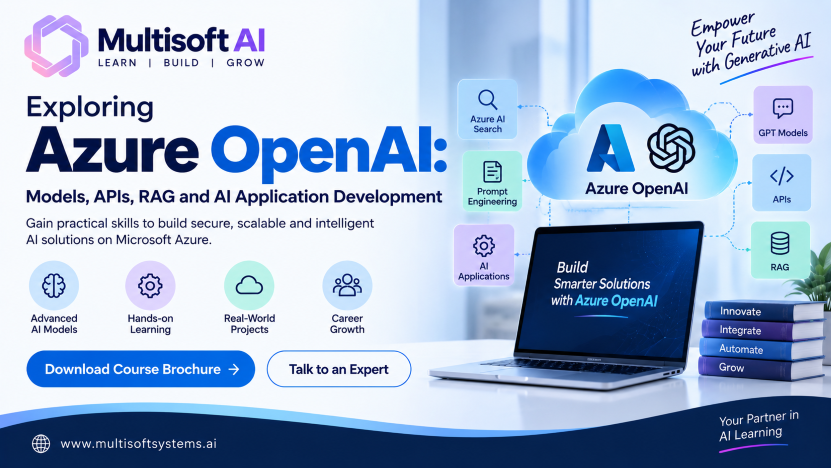
Exploring Azure OpenAI: Models, APIs, RAG and AI Application Development
Artificial Intelligence is moving rapidly from experimentation into real business applications. Organizations are using Generative AI to improve customer support, automate workflows, summarize documents, search enterprise information, assist employees and create intelligent applications. Microsoft Azure provides an enterprise-focused environment for developing and managing these solutions through Azure OpenAI and related Azure AI services. For professionals who want to work with enterprise Generative AI, Azure OpenAI Training offers a practical way to understand the platform, AI models, APIs, prompt engineering, Retrieval-Augmented Generation (RAG), Azure AI Search, security and application development.
Multisoft AI's Azure OpenAI program is designed to help learners understand the integration of Azure cloud capabilities with OpenAI technologies. The training combines foundational concepts with practical learning, real-time projects and application development.
What Is Azure OpenAI?
Azure OpenAI is a Microsoft Azure service that provides access to advanced OpenAI models within the Azure cloud environment. It enables organizations to use Generative AI capabilities for applications such as text generation, conversational assistants, content creation, document processing and intelligent automation. Azure OpenAI can also be integrated with other Azure services, allowing businesses to connect AI models with applications, enterprise data and cloud-based workflows. Learning Azure OpenAI helps professionals understand how Generative AI can be developed and deployed in an enterprise environment.
Why Learn Azure OpenAI?
Learning Azure OpenAI can help professionals understand how modern Generative AI technologies can be developed and integrated into business applications.
Key Reasons to Learn Azure OpenAI
- Understand enterprise Generative AI concepts
- Learn how Azure OpenAI services work
- Explore GPT and embedding models
- Develop AI-powered applications
- Learn practical prompt engineering
- Work with Azure OpenAI APIs
- Understand model deployment
- Build conversational AI solutions
- Learn Retrieval-Augmented Generation (RAG)
- Work with vector and semantic search
- Explore Azure AI Search integration
- Understand AI security and responsible AI
- Develop cloud-based AI development skills
- Prepare for emerging AI and Generative AI roles
Azure OpenAI vs Public OpenAI
| Feature | Azure OpenAI | Public OpenAI |
| Platform | Runs within the Microsoft Azure ecosystem | Provided through OpenAI's platform |
| Enterprise Integration | Designed for integration with Azure services and enterprise environments | Primarily accessed through OpenAI services and APIs |
| Cloud Environment | Part of Microsoft Azure | OpenAI's cloud platform |
| AI Models | Provides access to supported OpenAI models through Azure | Provides access to models available through OpenAI |
| Enterprise Security | Uses Azure security and governance capabilities | Uses OpenAI's platform security capabilities |
| Data Integration | Can connect with Azure services and enterprise data solutions | Can be integrated through available APIs and tools |
| AI Search Integration | Can work with Azure AI Search for enterprise applications | Requires separate search or retrieval integrations |
| Application Development | Suitable for enterprise AI applications within Azure | Suitable for applications developed using OpenAI services |
| Best Suited For | Organizations already using or planning to use Microsoft Azure | Developers and organizations using OpenAI's direct platform |
Understanding Azure OpenAI Models
Understanding the available AI models is an important part of working with Azure OpenAI. Different models can support different application requirements, so professionals need to consider capabilities, performance, context requirements and the type of task they want to accomplish. Training can introduce learners to GPT models, embedding models, tokens and context windows. It can also help professionals understand model selection and deployment considerations. This knowledge is useful when developing applications for content generation, conversational AI, document analysis and enterprise knowledge management.
Azure AI Studio and Model Deployment
Azure AI Studio provides an environment for working with AI solutions, experimenting with models and developing AI-powered applications. Professionals can learn how to configure workspaces, manage resources, explore models and deploy AI models for application development. Model deployment is an important step because it connects an AI model with an application or service. Learning deployment concepts helps professionals understand how models can move from experimentation into practical solutions. Training may also introduce tools such as playgrounds and Prompt Flow for testing and developing AI workflows.
Prompt Engineering with Azure OpenAI
Prompt engineering involves creating clear and effective instructions for Generative AI models. A well-designed prompt provides the model with the task, context, expectations and desired output format. With Azure OpenAI, professionals can learn different prompting approaches, including zero-shot and few-shot prompting, role-based instructions and contextual prompting. They can also explore techniques for improving prompt quality, testing outputs and reducing common prompting mistakes. Effective prompt engineering can support applications such as AI assistants, content generation, customer support, document summarization and business analysis.
Working with Azure OpenAI APIs
Azure OpenAI APIs allow developers to integrate AI capabilities into applications and software systems. Instead of using AI only through a standalone interface, developers can connect models with websites, applications, workflows and enterprise platforms. Training can cover API fundamentals, authentication, security, requests and responses, Chat Completions and Embeddings APIs. Developers can also learn about error handling and API best practices. This provides a foundation for building applications that communicate programmatically with Azure OpenAI services.
Building AI-Powered Applications
Azure OpenAI can be used to develop applications that combine Generative AI with business processes and user experiences. Professionals can explore how AI models can support different application scenarios.
Common applications include:
- AI chatbots
- Virtual assistants
- Content-generation tools
- Document summarization applications
- Customer-support solutions
- Knowledge assistants
- Business productivity applications
- Intelligent automation solutions
Learning application development helps professionals understand how AI models can be integrated into practical business workflows rather than being used only as standalone tools.
Embeddings and Vector Search
Embeddings convert information into numerical representations that capture semantic relationships. They are useful when an application needs to find information based on meaning rather than exact keyword matches. Vector search uses these representations to identify information that is semantically similar to a user's query. This makes embeddings and vector search important components of modern AI applications, particularly knowledge-based systems. Professionals can learn concepts such as embeddings, vector representations, similarity search, semantic search and vector databases. These skills can support enterprise search, recommendation systems and AI knowledge applications.
Retrieval-Augmented Generation with Azure OpenAI
Retrieval-Augmented Generation (RAG) combines information retrieval with Generative AI. Instead of depending only on information contained within a model, a RAG application retrieves relevant information from an external knowledge source and provides it to the model as context. A typical RAG process can be represented as user query → information retrieval → relevant context → AI model → generated response. With Azure OpenAI, RAG can be used to develop enterprise knowledge assistants, document-based applications and intelligent search solutions. Learning RAG fundamentals helps professionals understand data ingestion, indexing, retrieval and context-based response generation.
Azure AI Search Integration
Azure AI Search can provide search and retrieval capabilities for AI-powered applications. When combined with Azure OpenAI, it can help applications retrieve relevant information from enterprise data before generating a response.
Professionals can explore concepts such as:
- Search indexes
- Semantic search
- Vector search
- Hybrid search
- Data retrieval
- Knowledge-base integration
- Azure OpenAI integration
This combination can be particularly useful for enterprise knowledge assistants, document-search applications and RAG-based solutions.
Who Should Learn Azure OpenAI?
- Software developers
- AI and Machine Learning professionals
- Cloud professionals
- Azure professionals
- Solution architects
- Data professionals
- Generative AI developers
- Technology consultants
- IT professionals
- Application developers
- Professionals building AI-powered applications
- Professionals interested in enterprise Generative AI
Skills Covered in Azure OpenAI Training
- Azure OpenAI fundamentals
- Generative AI concepts
- Azure OpenAI architecture
- GPT models
- Embedding models
- Model selection
- Azure AI Studio
- Model deployment
- Prompt engineering
- Zero-shot and few-shot prompting
- Prompt optimization
- Azure OpenAI APIs
- API authentication and security
- Chat Completions
- Embeddings APIs
- AI application development
- Vector search
- Semantic search
- RAG architecture
- Azure AI Search
- Enterprise knowledge applications
- Responsible AI
- AI security and governance
Benefits of Learning Azure OpenAI
Learning Azure OpenAI can help professionals develop practical knowledge of enterprise Generative AI and understand how AI models can be integrated into cloud-based applications.
Key benefits include:
- Develop enterprise Generative AI skills
- Understand Azure OpenAI architecture
- Learn to work with GPT and embedding models
- Improve prompt engineering skills
- Understand AI model deployment
- Develop AI-powered applications
- Learn Azure OpenAI API integration
- Understand embeddings and vector search
- Build knowledge-based AI solutions
- Learn RAG fundamentals
- Explore Azure AI Search
- Understand AI security and responsible AI
- Gain practical cloud-based AI knowledge
- Prepare for emerging AI-focused career opportunities
Azure OpenAI Certification
An Azure OpenAI Certification can provide formal recognition of knowledge gained through structured learning. However, certification is most valuable when combined with practical experience and the ability to apply AI concepts to real-world projects. A structured training program can help learners prepare by covering Azure OpenAI models, APIs, prompt engineering, application development, RAG, Azure AI Search and responsible AI. Practical exercises and projects can further strengthen the understanding developed during training. Multisoft AI's program also provides certification as part of its learning experience, along with expert-led sessions, practical learning, assessments and access to learning resources.
Azure OpenAI Training Online
Azure OpenAI Training Online provides professionals with the flexibility to learn enterprise Generative AI technologies from their preferred location. Live instructor-led sessions can combine theoretical explanations with practical exercises, demonstrations, assignments and project-based learning. Multisoft AI offers live online training along with one-to-one learning and customized corporate training options. Learners can work through topics such as Azure OpenAI models, APIs, prompt engineering, RAG, vector search and Azure AI Search while receiving guidance from trainers. Online learning can be particularly useful for working professionals who want to develop Azure OpenAI skills without interrupting their existing work schedules.
Career Opportunities After Learning Azure OpenAI
- Azure OpenAI Developer
- Generative AI Developer
- AI Engineer
- Machine Learning Engineer
- AI Application Developer
- Cloud AI Engineer
- AI Solutions Architect
- Generative AI Consultant
- AI Solutions Consultant
- Prompt Engineer
- AI Automation Specialist
- Enterprise AI Developer
- AI Business Analyst
- AI Product Specialist
- AI Integration Developer
Practical Learning and Real-World Projects
Practical experience is an important part of developing Azure OpenAI skills. Understanding models, APIs and RAG concepts provides a foundation, but working on projects helps learners understand how these components operate together in real applications. Hands-on projects can involve model deployment, prompt development, API integration, chatbot creation, embeddings, vector search, RAG workflows and Azure AI Search. Such exercises allow learners to move from theoretical concepts toward practical AI application development. Multisoft AI's training approach includes practical learning, real-time projects, assignments and opportunities to develop AI-powered applications.
Why Choose Multisoft AI?
Multisoft AI provides a structured learning experience focused on practical Azure OpenAI skills.
Key features include:
- 32+ hours of expert-led training
- Globally recognized certification
- Interactive live masterclasses
- Practical, hands-on learning
- AI-powered application development
- Multiple AI tools
- Unlimited practice assessments
- Lifetime LMS access
- Recorded live sessions
- One-to-one training
- Live instructor-led online training
- Corporate training options
- Industry-relevant projects
- Certification guidance
- Post-training support
The program is available through one-to-one, live online and customized corporate learning formats.
Frequently Asked Questions
What is Azure OpenAI Training?
Azure OpenAI Training is a structured learning program that teaches professionals how to work with Azure OpenAI services, AI models, APIs, prompt engineering, RAG, Azure AI Search, security and AI application development.
Who can attend Azure OpenAI Training?
The training is suitable for developers, cloud professionals, AI engineers, solution architects and organizations interested in implementing Generative AI solutions on Microsoft Azure.
Is programming experience required?
Basic programming knowledge is recommended because the training includes APIs, Azure services and application integration. Familiarity with Python and basic AI or machine learning concepts can also be helpful.
What will I learn in an Azure OpenAI Online Course?
You can learn Azure OpenAI fundamentals, GPT models, embeddings, Azure AI Studio, prompt engineering, APIs, AI application development, vector search, RAG, Azure AI Search and enterprise AI security.
Can I learn RAG with Azure OpenAI?
Yes. The course includes RAG architecture, data ingestion, indexing, knowledge-base integration, context retrieval, response generation and RAG best practices.
Conclusion
Azure OpenAI is helping organizations move Generative AI from experimentation into practical enterprise applications. Professionals who understand AI models, cloud infrastructure, APIs, prompting, retrieval, search and security can play an important role in developing these solutions. Azure OpenAI Training provides a structured pathway to learn these technologies through foundational concepts, practical exercises, application development and real-world projects. Multisoft AI's program covers Azure OpenAI, GPT models, Azure AI Studio, prompt engineering, APIs, embeddings, vector search, RAG, Azure AI Search and responsible AI. For developers, cloud professionals, AI engineers and solution architects, building Azure OpenAI skills can be a valuable step toward working with enterprise Generative AI. With flexible online learning, one-to-one instruction and corporate training options, learners can choose an approach that fits their professional requirements.
Ready to develop practical Azure OpenAI skills? Explore Multisoft AI's program and take the next step toward building secure, scalable and intelligent AI applications.
About the Author