Generative AI Explained: How It Works, Use Cases, Benefits, and Future
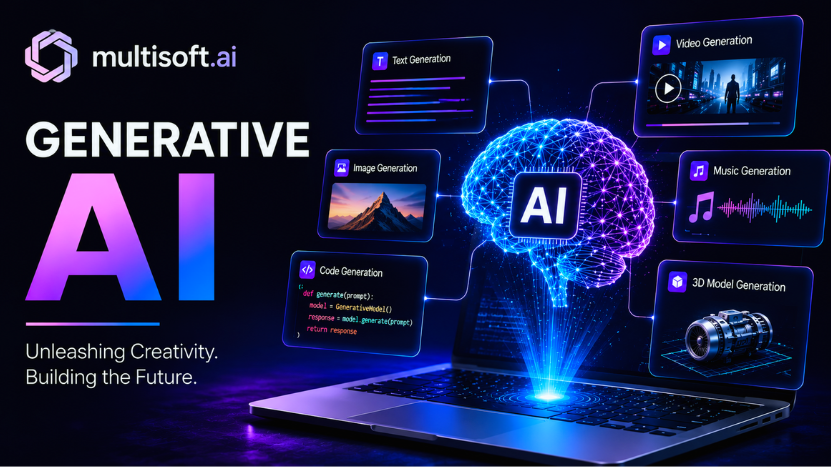
Generative AI has emerged as one of the most transformative technologies of the digital era, reshaping how individuals and businesses create, innovate, and solve complex problems. Unlike traditional artificial intelligence systems that focus on analyzing data or making predictions, Generative AI can produce entirely new content, including text, images, videos, audio, code, and even 3D designs. Powered by advanced machine learning models such as Large Language Models (LLMs) and diffusion models, it enables users to generate high-quality content with simple natural language prompts.From automating customer support and accelerating software development to creating marketing campaigns and enhancing healthcare research, Generative AI is revolutionizing nearly every industry. Organizations are leveraging this technology to improve productivity, reduce operational costs, and deliver personalized experiences at an unprecedented scale. At the same time, professionals are rapidly acquiring Generative AI skills to stay competitive in an AI-driven workplace.
This comprehensive guide explores everything you need to know about Generative AI, including its history, working principles, core technologies, applications, benefits, challenges, ethical considerations, career opportunities, and future trends. Whether you are a beginner curious about artificial intelligence or an experienced professional looking to deepen your expertise, this guide will provide valuable insights to help you understand and harness the power of Generative AI in today's rapidly evolving digital landscape.
What is Generative AI?
Generative AI Training is a branch of artificial intelligence that enables computers to create original content by learning patterns from large amounts of existing data. Unlike traditional AI systems, which primarily analyze information, classify data, or make predictions, Generative AI can generate new text, images, videos, music, computer code, audio, and other digital content based on user prompts. It relies on advanced machine learning techniques, particularly deep learning and neural networks, to understand context, recognize relationships within data, and produce human-like outputs. Popular Generative AI models, such as Large Language Models (LLMs) and diffusion models, are trained on vast datasets to perform a wide range of creative and analytical tasks. Today, businesses across industries use Generative AI to automate workflows, improve customer experiences, accelerate software development, support decision-making, create marketing content, and drive innovation. As the technology continues to evolve, Generative AI is becoming an essential tool for professionals and organizations seeking to enhance productivity, creativity, and operational efficiency in the digital age.
How Generative AI Works
Generative AI works by learning patterns, structures, and relationships from massive datasets, enabling it to create new content that closely resembles human-created work. It uses advanced machine learning algorithms, particularly deep learning and neural networks, to understand language, images, audio, code, and other types of data. Once trained, the AI model can generate meaningful responses based on user inputs, known as prompts.
- Data Collection
Data collection is the first step in building a Generative AI model. Large amounts of data, including text, images, videos, audio, and source code, are gathered from books, websites, research papers, public datasets, and other digital sources. A diverse and high-quality dataset enables the model to learn language patterns, concepts, and relationships more effectively, resulting in accurate and meaningful outputs.
- Data Preprocessing
Before training begins, the collected data undergoes preprocessing to improve its quality and consistency. This process includes removing duplicate or irrelevant information, correcting formatting issues, filtering inappropriate content, and converting data into a structured format. Proper preprocessing helps reduce noise and improves the efficiency and accuracy of the AI model during training.
- Model Training
During model training, the AI system analyzes billions of data examples to identify patterns, grammar, context, and relationships. Using deep learning algorithms, the model continuously adjusts its internal parameters to minimize prediction errors. This stage requires significant computational resources and can take weeks or even months, depending on the model's size and the volume of training data.
- Transformer Architecture
Most modern Generative AI systems are built on the Transformer architecture, a deep learning framework introduced to process sequential data more efficiently. Unlike earlier neural network models, Transformers can analyze all parts of an input simultaneously, enabling them to understand long-range relationships and context. This architecture has significantly improved the speed, scalability, and performance of large language models.
- Tokenization
Tokenization is the process of breaking input text into smaller units called tokens. A token may represent a word, part of a word, punctuation mark, or symbol. These tokens allow the AI model to process language more effectively, understand sentence structure, and generate coherent responses by predicting one token at a time.
- Embeddings
Embeddings convert tokens into numerical vectors that capture their meanings and relationships. Words with similar meanings are represented by vectors located close to each other in a mathematical space. This enables the AI model to recognize semantic similarities, understand context, and generate responses that are both relevant and meaningful.
- Self-Attention Mechanism
The self-attention mechanism allows the model to determine which words or tokens are most important when interpreting a sentence. Instead of processing words one by one, it evaluates the relationships among all tokens simultaneously. This helps the model understand context, resolve ambiguities, and generate more accurate and natural-sounding responses.
- Prompt Processing
When a user submits a prompt, the AI first analyzes the input to identify the user's intent, context, and relevant information. The prompt is tokenized, converted into embeddings, and processed through multiple neural network layers. This enables the model to understand the request before generating an appropriate response.
- Content Generation
Once the prompt has been processed, the model begins generating content by predicting the most probable next token based on the context. This prediction process continues repeatedly until a complete response is produced. Depending on the user's request, the generated output may include text, code, images, summaries, reports, or other forms of digital content.
- Fine-Tuning
Fine-tuning is the process of adapting a pre-trained AI model for a specific domain, industry, or task using specialized datasets. Instead of training a model from scratch, organizations refine an existing model to improve its performance in areas such as healthcare, finance, legal services, customer support, or software development. Fine-tuning enhances accuracy, relevance, and domain-specific knowledge while reducing training time and costs.
- Reinforcement Learning from Human Feedback (RLHF)
Reinforcement Learning from Human Feedback (RLHF) is a technique used to improve the quality and safety of AI-generated responses. Human evaluators review multiple outputs generated by the model and rank them based on accuracy, relevance, clarity, and helpfulness. The model uses this feedback to adjust its behavior, producing responses that better align with human expectations and ethical guidelines.
- Output Generation
Output generation is the final stage of the Generative AI process. After analyzing the prompt and predicting the most suitable sequence of tokens, the model delivers a complete response to the user. Depending on the application, the output may be a written article, computer code, image, audio clip, video, business report, or other digital content. Advanced models also refine the output to ensure it is coherent, contextually accurate, and aligned with the user's request.
Types of Generative AI Models
Generative AI consists of several types of models, each designed for specific content generation tasks. Large Language Models (LLMs) are widely used for generating human-like text, answering questions, summarizing documents, and writing code. Generative Adversarial Networks (GANs) create realistic images, videos, and synthetic data by using two neural networks that compete with each other during training. Diffusion Models generate high-quality images by gradually removing noise from random data and are commonly used in AI image generation tools. Variational Autoencoders (VAEs) are used to create new data samples while preserving the characteristics of the original dataset, making them useful in image synthesis and anomaly detection. Transformer-based models excel at understanding context and generating coherent text, while Multimodal Models can process and generate multiple data types such as text, images, audio, and video simultaneously. These advanced models power today's most popular Generative AI applications across industries.
Generative AI Use Cases
- Content Writing and Blogging
- AI Chatbots and Virtual Assistants
- Customer Support Automation
- Software Development and Code Generation
- Image Creation and Graphic Design
- Video Generation and Editing
- Music Composition
- Voice Generation and Speech Synthesis
- Marketing Content Creation
- Social Media Content Generation
- Email Drafting and Personalization
- Product Description Generation
- Document Summarization
- Language Translation
- Medical Research and Drug Discovery
- Financial Analysis and Reporting
- Fraud Detection Support
- Personalized Learning and Education
- Resume and Cover Letter Writing
- Legal Document Drafting
- Business Process Automation
- AI-Powered Search and Knowledge Management
- Game Development
- Product Design and Prototyping
- Data Analysis and Report Generation
- AI Agents and Autonomous Workflows
Benefits of Generative AI
Generative AI offers numerous benefits that help individuals and organizations improve productivity, creativity, and operational efficiency. It automates repetitive tasks such as content creation, report generation, customer support, and software coding, allowing professionals to focus on higher-value activities. Businesses use Generative AI to reduce operational costs, accelerate product development, and deliver personalized customer experiences. The technology enables faster decision-making by generating insights from large volumes of data and supports innovation by creating new ideas, designs, and solutions in a matter of seconds. It also enhances collaboration by assisting teams with research, documentation, and communication. Across industries such as healthcare, finance, education, retail, and manufacturing, Generative AI improves efficiency, increases scalability, boosts customer satisfaction, and helps organizations remain competitive in an increasingly digital and AI-driven marketplace.
Challenges and Limitations
Despite its remarkable capabilities, Generative AI has several challenges and limitations. AI models can sometimes produce inaccurate or misleading information, commonly known as hallucinations, which may affect decision-making if not verified by humans. The quality of generated content depends heavily on the training data and user prompts. Developing and training large AI models requires significant computational resources, specialized hardware, and substantial financial investment. Privacy concerns arise when sensitive or proprietary data is used during training or inference. Bias present in training datasets may also result in unfair or discriminatory outputs. Additionally, Generative AI lacks genuine human understanding, emotions, and common sense, making human oversight essential for critical applications. Organizations must also address regulatory compliance, copyright issues, data security, and ethical concerns when implementing Generative AI solutions.
Risks of Generative AI
While Generative AI provides significant advantages, it also introduces various risks that organizations and individuals must manage carefully. AI-generated deepfakes, fake news, and misinformation can spread rapidly and influence public opinion. Cybercriminals may use Generative AI to create sophisticated phishing emails, malware, or social engineering attacks. Intellectual property and copyright disputes may arise when AI-generated content closely resembles existing works. Privacy risks increase when confidential data is shared with AI systems without proper safeguards. AI bias can lead to unfair decisions in recruitment, lending, healthcare, and legal processes. Excessive dependence on AI may reduce human creativity and critical thinking, while inaccurate outputs can negatively impact business operations. To minimize these risks, organizations should implement responsible AI practices, robust governance, security controls, and continuous human supervision.
Skills Required to Learn Generative AI
Learning Generative AI requires a combination of technical knowledge, analytical thinking, and practical problem-solving skills. A strong foundation in programming, particularly Python, is essential because it is the primary language used for developing AI and machine learning applications. Understanding mathematics, including linear algebra, probability, statistics, and calculus, helps learners grasp how AI algorithms function. Knowledge of machine learning and deep learning concepts, such as neural networks, supervised learning, unsupervised learning, and transformer models, is equally important. Familiarity with Natural Language Processing (NLP), computer vision, prompt engineering, fine-tuning, and Retrieval-Augmented Generation (RAG) enables learners to build advanced AI applications. Experience with popular AI frameworks such as TensorFlow, PyTorch, Hugging Face Transformers, LangChain, and vector databases further strengthens practical expertise. Cloud platforms like AWS, Microsoft Azure, and Google Cloud are valuable for deploying and managing AI solutions at scale. In addition to technical skills, learners should develop logical reasoning, communication, creativity, and continuous learning habits, as Generative AI is a rapidly evolving field. Hands-on projects, real-world case studies, experimentation with AI tools, and staying updated with emerging technologies are essential for becoming a successful Generative AI professional and building innovative AI-powered solutions for modern business challenges.
Conclusion
Generative AI is transforming the way people work, create, and innovate by enabling machines to generate human-like text, images, code, audio, and other digital content. From enhancing business productivity and automating repetitive tasks to accelerating research and improving customer experiences, its applications continue to expand across industries. As organizations increasingly adopt AI-driven solutions, professionals with expertise in Generative AI, prompt engineering, fine-tuning, and AI automation are becoming highly sought after. While the technology offers immense opportunities, it also brings challenges related to ethics, privacy, security, and responsible usage, making human oversight essential. By understanding how Generative AI works, exploring its use cases, and developing the right technical skills, individuals can unlock exciting career opportunities and contribute to the next wave of digital transformation. As the technology continues to evolve, Generative AI will remain a powerful force driving innovation, efficiency, and intelligent decision-making, shaping the future of businesses and society alike. Enroll in Multisoft Ai now!
About the Author