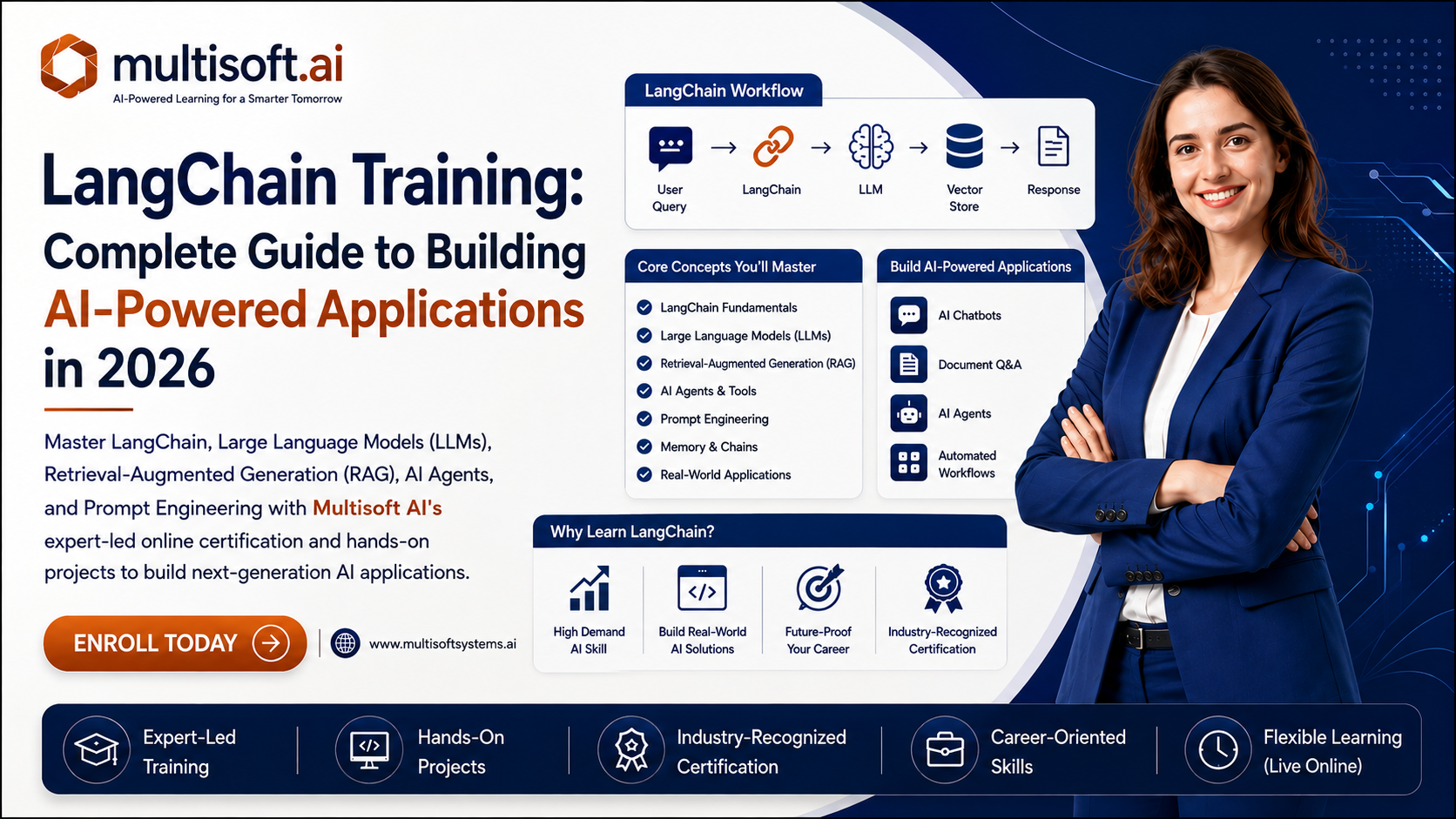
LangChain Training: Complete Guide to Building AI-Powered Applications in 2026
Artificial Intelligence is evolving rapidly, and businesses are looking for smarter ways to build applications powered by Large Language Models (LLMs). LangChain has emerged as one of the most popular open-source frameworks for developing AI applications that can understand context, connect with external data sources, and automate complex workflows. From intelligent chatbots and virtual assistants to document search and enterprise AI solutions, LangChain is helping developers create more powerful and scalable AI systems. As Generative AI adoption continues to grow in 2026, the demand for professionals with LangChain Training is increasing across industries. Whether you are a software developer, AI engineer, data scientist, or technology enthusiast, learning LangChain can help you build next-generation AI applications and unlock exciting career opportunities.
This guide explains what LangChain is, why it is trending, its key features, business benefits, and how learning LangChain can prepare you for the future of AI development.
Why LangChain is Trending in 2026
The rapid growth of Generative AI has transformed how businesses build intelligent applications. In 2026, organizations are moving beyond simple AI chatbots and developing advanced AI assistants capable of understanding context, retrieving information from multiple data sources, and performing complex tasks. LangChain has become a preferred framework because it simplifies the development of applications powered by Large Language Models (LLMs). It enables developers to connect AI models with databases, APIs, cloud services, and enterprise systems, making AI applications more practical, reliable, and scalable. As businesses continue investing in AI automation, personalized customer experiences, and intelligent decision-making, LangChain is becoming an essential technology for developers and AI professionals who want to build enterprise-ready AI solutions.
What is LangChain?
LangChain Training is an open-source framework designed to help developers build applications powered by Large Language Models (LLMs) such as OpenAI GPT, Anthropic Claude, Google Gemini, and other AI models. It provides a set of tools and components that make it easier to create intelligent applications capable of understanding user queries, retrieving relevant information, maintaining conversation context, and interacting with external systems. Instead of using a language model alone, LangChain allows developers to combine AI with databases, APIs, vector stores, memory, and workflow automation to build advanced applications such as AI chatbots, virtual assistants, document search systems, knowledge management platforms, and AI agents. Its modular architecture, flexibility, and support for multiple AI providers have made LangChain one of the most widely adopted frameworks in modern AI application development.
Why Businesses Are Adopting LangChain
Businesses across industries are adopting LangChain because it enables them to develop intelligent AI applications that deliver accurate, context-aware, and personalized responses. Unlike traditional AI implementations that rely only on static datasets, LangChain allows applications to access real-time information, integrate with business systems, and automate complex workflows. This makes it an ideal solution for organizations looking to improve customer service, streamline operations, enhance employee productivity, and accelerate digital transformation. From AI-powered customer support and enterprise search to document analysis and workflow automation, LangChain helps businesses build scalable AI solutions that solve real-world challenges. As organizations increasingly invest in Generative AI, LangChain has become a key technology for creating secure, reliable, and enterprise-ready AI applications.
Key Features of LangChain
- Build intelligent applications powered by Large Language Models (LLMs).
- Connect AI models with external databases and knowledge sources.
- Support Retrieval-Augmented Generation (RAG) for accurate responses.
- Integrate with APIs, cloud services, and enterprise applications.
- Maintain conversation memory for context-aware interactions.
- Develop AI agents capable of performing multi-step tasks.
- Create advanced AI chatbots and virtual assistants.
- Support multiple AI models, including OpenAI, Claude, and Gemini.
- Enable document processing, search, and knowledge management.
- Simplify prompt management and AI workflow orchestration.
- Provide modular components for faster AI application development.
- Scale AI solutions for enterprise-level deployments.
- Improve response accuracy using external data retrieval.
- Support flexible integration with vector databases and embeddings.
- Accelerate the development of production-ready Generative AI applications.
LangChain vs Traditional AI Development
| Feature | LangChain | Traditional AI Development |
| AI Integration | Easily integrates with Large Language Models (LLMs) like OpenAI, Claude, and Gemini | Requires custom integration with AI models |
| Context Awareness | Maintains conversation memory and context | Limited context handling |
| External Data Access | Connects to databases, APIs, vector stores, and documents | Mostly relies on static or preprocessed datasets |
| Workflow Automation | Supports AI agents and multi-step workflows | Requires significant custom coding |
| Development Speed | Faster development with reusable components | Time-consuming and code-intensive |
| Scalability | Designed for enterprise-scale AI applications | Scaling often requires additional development effort |
| Prompt Management | Built-in prompt templates and chaining capabilities | Manual prompt handling |
| Real-Time Data Retrieval | Supports Retrieval-Augmented Generation (RAG) | Limited support for real-time information |
| Flexibility | Modular architecture with multiple integrations | Less flexible and harder to extend |
| Best Use Cases | AI assistants, chatbots, enterprise search, automation | Traditional predictive models and standalone AI applications |
Latest Industry Trends
Generative AI continues to reshape industries, and LangChain has become one of the most widely adopted frameworks for building intelligent AI applications. Businesses are increasingly moving from basic AI chatbots to advanced AI agents that can retrieve real-time information, automate workflows, and make context-aware decisions. The growing adoption of Retrieval-Augmented Generation (RAG), AI copilots, multi-agent systems, and enterprise knowledge assistants has further increased the demand for LangChain. Organizations are also integrating LangChain with cloud platforms, vector databases, and business applications to build secure, scalable, and production-ready AI solutions. As AI becomes a core part of digital transformation strategies, LangChain is playing a significant role in accelerating enterprise AI development.
Real-World Applications
LangChain is used to develop intelligent AI applications across a wide range of industries.
- AI-powered customer support chatbots
- Virtual assistants for businesses
- Enterprise knowledge management systems
- Intelligent document search and analysis
- Healthcare information assistants
- Banking and financial support bots
- HR onboarding and employee support assistants
- E-commerce product recommendation systems
- AI-powered educational tutors
- Legal document analysis and research
- IT help desk automation
- Sales and marketing assistants
- Research and content generation platforms
- AI workflow automation solutions
- Internal enterprise AI copilots
Skills You'll Learn
By learning LangChain Training, participants develop practical skills required to build modern AI-powered applications.
- Understand LangChain architecture and components.
- Build applications using Large Language Models (LLMs).
- Learn Prompt Engineering techniques.
- Develop Retrieval-Augmented Generation (RAG) applications.
- Connect AI models with APIs and databases.
- Integrate vector databases for intelligent search.
- Build AI chatbots and virtual assistants.
- Create AI agents for workflow automation.
- Manage conversation memory and context.
- Design scalable enterprise AI applications.
- Understand embeddings and semantic search.
- Deploy AI applications using modern development practices.
- Build real-world Generative AI projects.
- Apply AI solutions across multiple industries.
Who Should Learn LangChain?
LangChain Training is suitable for anyone interested in building intelligent AI applications and advancing their career in Artificial Intelligence.
- Software Developers
- AI Engineers
- Machine Learning Engineers
- Data Scientists
- Python Developers
- Prompt Engineers
- Full Stack Developers
- Cloud Engineers
- DevOps Professionals
- IT Professionals transitioning into AI
- AI Researchers
- Technical Architects
- Students and Fresh Graduates
- Technology Enthusiasts
- Entrepreneurs developing AI products
Career Opportunities
The rapid adoption of Generative AI has created strong demand for professionals with LangChain expertise. After completing LangChain Training, learners can pursue careers as AI Engineer, LangChain Developer, Prompt Engineer, Generative AI Engineer, Machine Learning Engineer, NLP Engineer, AI Solutions Architect, Full Stack AI Developer, AI Consultant, and LLM Application Developer. These professionals design AI-powered chatbots, enterprise AI assistants, Retrieval-Augmented Generation (RAG) systems, intelligent search applications, and workflow automation solutions. Industries such as IT, healthcare, banking, retail, education, finance, manufacturing, and consulting are actively hiring professionals who can build scalable AI applications using LangChain and Large Language Models.
Future of LangChain
The future of LangChain looks highly promising as organizations continue investing in Generative AI and intelligent automation. Emerging technologies such as AI agents, autonomous workflows, Retrieval-Augmented Generation (RAG), multimodal AI, enterprise copilots, and agentic AI are expected to drive wider adoption of LangChain. As businesses increasingly rely on AI for decision-making, customer engagement, and workflow automation, LangChain will continue to evolve with improved integrations, enhanced scalability, and stronger enterprise capabilities. Professionals who develop expertise in LangChain today will be well-positioned to contribute to next-generation AI solutions and remain competitive in the rapidly growing AI industry.
Why Choose Multisoft AI for LangChain Training?
Choosing the right learning platform is essential for mastering emerging AI technologies. Multisoft AI offers a comprehensive LangChain Training program designed to help learners build practical skills in developing AI-powered applications using modern Generative AI technologies. The training combines expert-led sessions with hands-on learning to help participants understand LangChain fundamentals, Prompt Engineering, Large Language Models (LLMs), Retrieval-Augmented Generation (RAG), AI workflow automation, and enterprise AI application development. Through practical examples, real-world use cases, and project-based learning, learners gain valuable experience that can be applied across industries. Whether you are a beginner or an experienced professional, Multisoft AI provides a structured learning experience that helps you build future-ready AI skills and prepare for exciting career opportunities in the rapidly evolving field of Generative AI.
Conclusion
LangChain has become one of the most important frameworks for building intelligent applications powered by Large Language Models. As businesses increasingly adopt Generative AI, the need for professionals who can develop AI chatbots, enterprise assistants, Retrieval-Augmented Generation (RAG) systems, and workflow automation solutions continues to grow. Learning LangChain Training equips you with practical skills to build scalable, context-aware AI applications that solve real business challenges across industries. Whether you are a software developer, AI engineer, data scientist, or technology enthusiast, mastering LangChain can significantly enhance your career prospects in the AI industry.
With expert-led instruction, hands-on projects, and industry-focused learning, Multisoft AI's LangChain Training helps learners develop the knowledge and confidence required to build next-generation AI solutions. Investing in LangChain skills today is a smart step toward becoming a future-ready AI professional and staying ahead in the rapidly evolving world of Artificial Intelligence.
About the Author