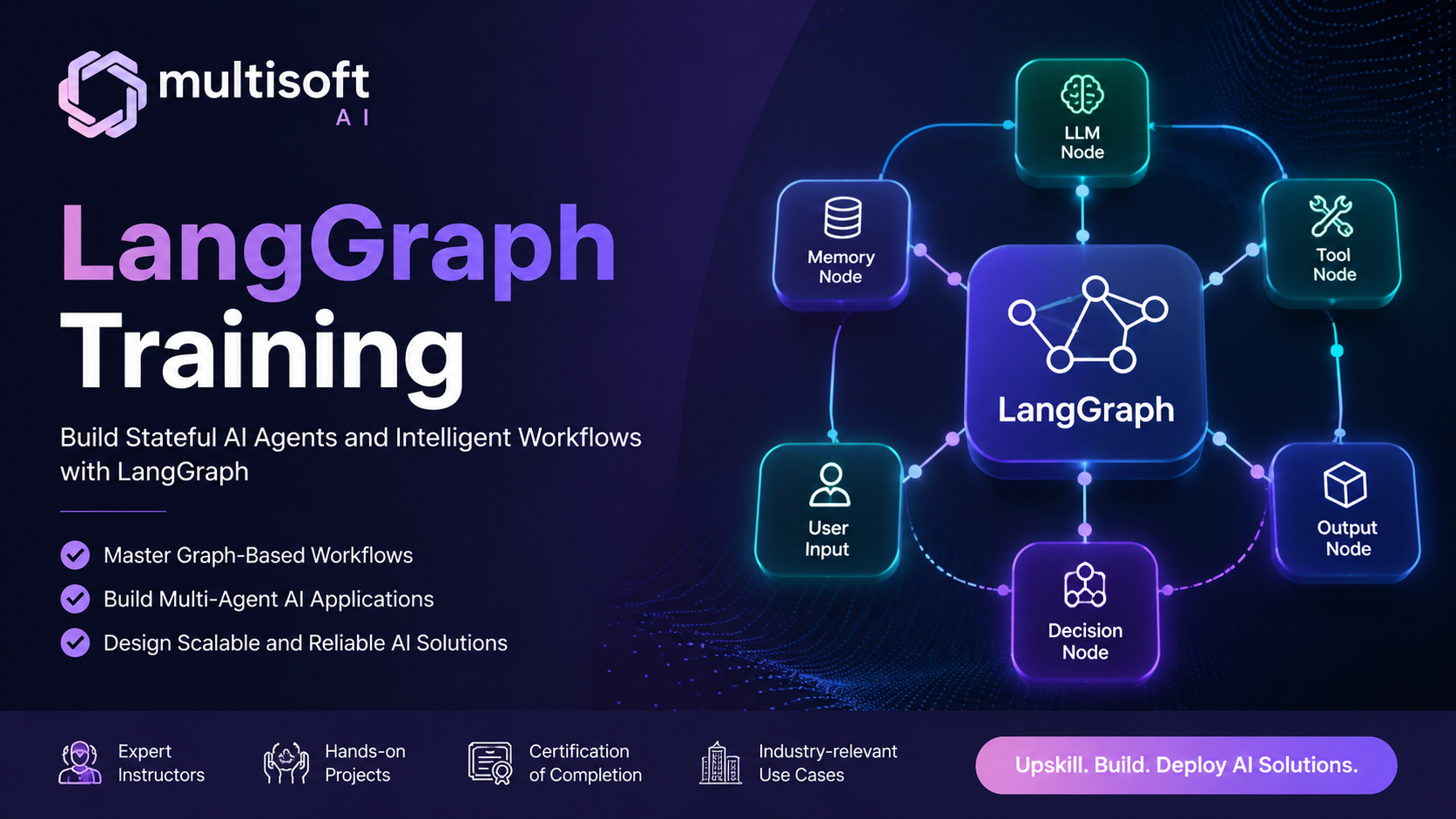
LangGraph: Building the Next Generation of AI Agents with Stateful Workflows
Artificial Intelligence has evolved far beyond simple chatbots and question-answering systems. Organizations today are looking for AI solutions that can reason, make decisions, collaborate with other AI systems, and execute complex business processes. This demand has led to the rise of AI agents, autonomous systems capable of performing tasks with minimal human intervention. However, building reliable and scalable AI agents requires more than just connecting a Large Language Model (LLM) to an application. It requires structured workflows, memory management, state tracking, and orchestration. This is where LangGraph comes into the picture.
LangGraph is an advanced framework designed for developing stateful, multi-step AI applications and agentic workflows. Built on top of LangChain, it enables developers to create AI systems that can maintain context, execute conditional logic, manage long-running tasks, and coordinate multiple agents efficiently. As businesses increasingly adopt AI-driven automation, LangGraph is becoming a preferred solution for creating robust and enterprise-ready AI applications.
Understanding LangGraph
LangGraph is a framework that allows developers to model AI workflows as graphs. Instead of following a simple linear execution path, applications can move between different nodes based on conditions, decisions, or user inputs. Each node represents a specific operation, such as calling an LLM, retrieving information, executing a tool, or processing data.
This graph-based architecture enables the creation of sophisticated AI systems that can handle dynamic decision-making, branching workflows, and multi-agent collaboration. Unlike traditional chatbot architectures, LangGraph provides mechanisms for maintaining state throughout the workflow, making it ideal for complex enterprise use cases.
Why Traditional AI Workflows Fall Short
Many AI applications are built using sequential chains where one step directly follows another. While this approach works for basic use cases, it becomes difficult to manage when applications require:
- Multi-step reasoning
- Dynamic decision-making
- Persistent memory
- Error recovery
- Human-in-the-loop approvals
- Multi-agent collaboration
- Long-running business processes
Traditional workflows often struggle to maintain context and adapt to changing conditions. LangGraph addresses these limitations by introducing graph-based orchestration and state management capabilities.
Core Components of LangGraph
Nodes
Nodes are the building blocks of a LangGraph application. Each node performs a specific task within the workflow. Examples include:
- LLM interactions
- Database queries
- API calls
- Data processing
- Tool execution
- User interaction handling
Nodes can be reused across multiple workflows, making development more modular and maintainable.
Edges
Edges define the flow between nodes. They determine how the workflow progresses from one task to another. Conditional edges enable intelligent routing based on outcomes or decisions generated during execution.
State Management
One of the most important features of LangGraph is state management. The framework allows workflows to maintain and update information throughout execution. This enables AI agents to remember previous actions, user preferences, and workflow progress.
Graph Execution Engine
The execution engine controls how nodes are processed and how transitions occur between different workflow stages. It ensures efficient execution while maintaining consistency across the entire workflow.
Key Features of LangGraph
Stateful AI Applications
LangGraph enables applications to maintain context across multiple interactions. This is particularly useful for customer support systems, virtual assistants, and business process automation.
Multi-Agent Systems
Organizations can build systems where multiple AI agents collaborate to solve complex tasks. Each agent can specialize in a particular function while working together within a coordinated workflow.
Human-in-the-Loop Integration
Many enterprise processes require human approval or intervention. LangGraph supports workflows where human users can review, modify, or approve AI-generated outputs before execution continues.
Error Handling and Recovery
Enterprise applications must be reliable. LangGraph provides mechanisms for handling failures gracefully and recovering from errors without disrupting the entire workflow.
Flexible Workflow Design
Developers can create highly customized workflows with branching logic, loops, conditional execution paths, and parallel processing.
How LangGraph Enhances AI Agent Development
AI agents need more than intelligence; they need structure. LangGraph provides that structure by enabling agents to:
- Track their progress
- Maintain memory
- Coordinate actions
- Make informed decisions
- Interact with external systems
- Collaborate with other agents
This transforms AI systems from simple conversational tools into intelligent digital workers capable of handling real business operations.
Enterprise Applications of LangGraph
Customer Service Automation
Organizations can build advanced support systems that:
- Understand customer intent
- Access relevant knowledge bases
- Escalate issues when necessary
- Maintain conversation history
- Coordinate with human agents
Business Process Automation
LangGraph can automate workflows involving:
- Document processing
- Approval chains
- Data validation
- Compliance checks
- Task orchestration
AI Research Assistants
Research teams can leverage LangGraph to:
- Gather information from multiple sources
- Analyze documents
- Summarize findings
- Generate reports
- Track research progress
Financial Services
Financial institutions can use LangGraph for:
- Risk assessment
- Fraud detection
- Regulatory compliance
- Client onboarding
- Portfolio analysis
Healthcare Operations
Healthcare organizations can implement workflows for:
- Patient intake
- Medical record analysis
- Appointment coordination
- Clinical decision support
- Compliance monitoring
LangGraph vs Traditional LangChain
Although LangGraph is built on LangChain, it introduces several advanced capabilities.
| Feature | LangChain | LangGraph |
|---|---|---|
| Sequential Workflows | Yes | Yes |
| Graph-Based Workflows | Limited | Yes |
| Stateful Execution | Basic | Advanced |
| Multi-Agent Systems | Partial | Comprehensive |
| Human-in-the-Loop | Limited | Native Support |
| Workflow Branching | Basic | Advanced |
| Long-Running Processes | Limited | Strong Support |
For simple applications, LangChain may be sufficient. However, enterprise-grade AI agent systems often benefit significantly from LangGraph's advanced orchestration capabilities.
Benefits of Learning LangGraph
Professionals who learn LangGraph gain expertise in one of the most important technologies in the emerging AI agent ecosystem.
Key benefits include:
- Understanding agentic AI architectures
- Building scalable AI workflows
- Developing enterprise-grade AI applications
- Creating multi-agent systems
- Implementing AI automation solutions
- Enhancing career opportunities in AI engineering
As organizations move toward autonomous AI systems, LangGraph expertise is becoming increasingly valuable across industries.
Skills Covered in LangGraph Training
A comprehensive LangGraph training program typically covers:
- Introduction to AI Agents
- LangChain Fundamentals
- LangGraph Architecture
- State Management
- Workflow Design
- Conditional Routing
- Multi-Agent Collaboration
- Tool Integration
- Memory Management
- Human-in-the-Loop Systems
- RAG Integration
- AI Automation Workflows
- Error Handling Strategies
- Deployment Best Practices
- Real-World Projects
Future of LangGraph and Agentic AI
The future of AI is moving toward autonomous systems capable of managing complex workflows and making intelligent decisions. LangGraph is positioned as a foundational technology in this transformation. As enterprises adopt AI-driven operations, the demand for professionals skilled in LangGraph, AI agents, and workflow orchestration will continue to grow.
Organizations are increasingly investing in intelligent automation platforms that combine reasoning, memory, and execution capabilities. LangGraph provides the framework needed to build these next-generation solutions efficiently and reliably.
Conclusion
LangGraph is revolutionizing the way AI agents and intelligent workflows are developed. By combining graph-based orchestration, state management, and multi-agent collaboration capabilities, it enables organizations to create sophisticated AI systems capable of handling real-world business challenges. Whether used for customer service, automation, research, finance, or healthcare, LangGraph provides the flexibility and scalability needed for enterprise AI applications.
For professionals seeking to build expertise in AI engineering and agentic AI development, learning LangGraph offers a significant advantage. As businesses continue to embrace intelligent automation, LangGraph skills will play a crucial role in designing, deploying, and managing the AI-powered solutions of the future.
About the Author