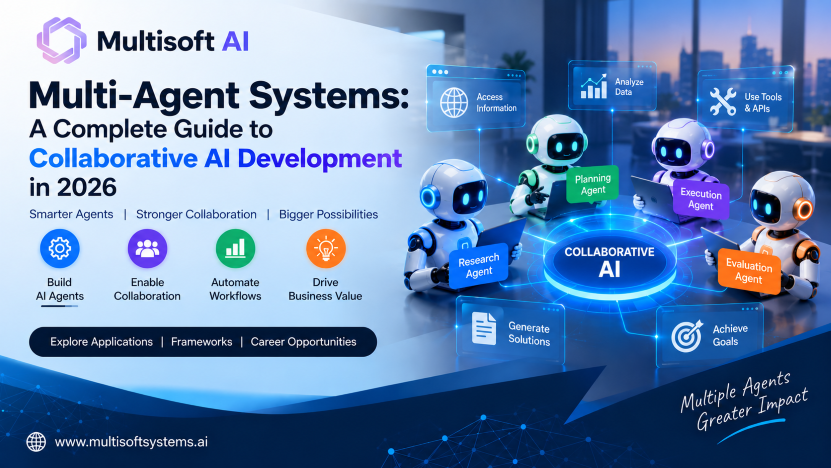
Multi-Agent Systems: A Complete Guide to Collaborative AI Development in 2026
Artificial Intelligence is entering a new phase where AI applications are expected to do more than generate answers. Modern systems can plan tasks, use external tools, retrieve information, make decisions and complete multiple steps with limited human intervention. This evolution is driving interest in multi-agent systems, where several specialized AI agents work together to achieve a shared objective. A multi-agent system can divide a complex problem into smaller responsibilities and assign those responsibilities to different agents. One agent may research information while another analyzes data, a third performs an action and another reviews the outcome. This collaborative approach can make AI workflows more organized and adaptable. The growing interest in agentic AI is also changing what developers need to learn. Instead of focusing only on individual AI models, professionals increasingly need to understand agent orchestration, communication, tool integration, memory, workflow design and responsible AI.
Multi-Agent Systems Training provides a structured path for learning these concepts and understanding how collaborative AI applications can be designed for real-world use.
What Are Multi-Agent Systems?
A multi-agent system is an AI architecture where multiple autonomous or semi-autonomous agents work together to complete a task or solve a complex problem. Each agent can have a specific role, objective, set of tools or area of expertise. The agents communicate, exchange information and coordinate their actions as part of a larger workflow. This approach distributes work across specialized agents instead of relying on one AI model to handle every stage.
Example: AI Market Research System
- Research Agent - Collects relevant market information and supporting data.
- Analysis Agent - Examines market data and identifies important patterns.
- Strategy Agent - Develops recommendations based on the analysis.
- Writer Agent - Prepares the final research report.
- Review Agent - Checks the report for accuracy, quality and completeness.
This architecture is especially useful for tasks that require different capabilities or several interconnected steps.
Why Are Multi-Agent Systems Trending in 2026?
The growth of agentic AI is one of the major developments shaping the AI landscape in 2026. Businesses are increasingly exploring systems that can perform tasks and interact with tools rather than simply respond to prompts. Multi-agent architectures are gaining attention because they can support complex workflows through collaboration. Several trends are contributing to this growth.
- Increasing AI Automation
Organizations want to automate repetitive and multi-step processes while keeping people involved where necessary.
- Growth of AI Agents
AI agents are becoming more capable of planning, reasoning, retrieving information and taking actions.
- Complex Enterprise Workflows
Business processes often involve multiple departments, systems and decisions. Multi-agent architectures can divide these responsibilities.
- Better AI Orchestration
Modern frameworks make it easier to coordinate multiple agents and manage their interactions.
- Human-AI Collaboration
Organizations are exploring systems where agents handle routine activities while people provide supervision and approval for important decisions.
- Expansion of Generative AI
Large Language Models provide the intelligence layer for many modern agents, creating new opportunities for collaborative AI applications.
How Do Multi-Agent Systems Work?
Multi-Agent Systems Training work by dividing a complex task into smaller responsibilities and assigning them to specialized AI agents. Each agent performs its assigned role, communicates relevant information with other agents and contributes to the overall workflow. A central coordinator or defined communication process can manage the sequence of actions, while agents use LLMs, external tools, APIs and shared data to complete their tasks. This collaborative approach enables AI systems to handle complex workflows more efficiently and produce more structured results.
Key Components of a Multi-Agent System
- AI Agents
Agents are specialized components responsible for completing specific tasks. They may have individual roles, goals, instructions, tools and memory.
- Communication
Agents need a mechanism for exchanging information. Effective communication helps agents understand previous actions and coordinate their next steps.
- Orchestration
Orchestration determines which agent should perform a task, when it should execute and what should happen afterward.
- Tools
Agents can use APIs, databases, search systems, calculators, code execution environments and other external resources.
- Memory
Memory allows agents to retain relevant information across steps or interactions.
- State
State represents the current condition of the workflow. It can include messages, tool results, decisions and intermediate outputs.
- Human Oversight
Human-in-the-loop mechanisms can allow people to review or approve actions before they are completed.
Multi-Agent Systems vs Single AI Agents
A single AI agent can be highly effective for focused tasks. However, complex workflows may benefit from dividing responsibilities across several specialized agents.
| Single AI Agent | Multi-Agent System |
| One primary agent | Multiple specialized agents |
| Centralized responsibility | Distributed responsibilities |
| Simpler architecture | More complex architecture |
| Suitable for focused tasks | Suitable for complex workflows |
| Limited specialization | Multiple areas of expertise |
| Easier to manage | Requires orchestration |
| Fewer communication requirements | Agent-to-agent communication |
The choice depends on the problem. A multi-agent system is not automatically better than a single agent. It becomes valuable when specialization and collaboration provide meaningful benefits.
Important Multi-Agent Architecture Patterns
Different applications require different collaboration models.
Sequential Pattern
Agents complete tasks one after another.
Research → Analysis → Writing → Review
This approach works well when each stage depends on the previous result.
Parallel Pattern
Several agents perform tasks at the same time.
Research Agent + Data Agent + Competitor Agent → Strategy Agent
Parallel execution can be useful when tasks are independent.
Hierarchical Pattern
A manager or coordinator agent assigns tasks to specialized agents and reviews their outputs.
Collaborative Pattern
Multiple agents communicate directly and work together to solve a problem.
Human-in-the-Loop Pattern
Agents perform automated work but pause when human input or approval is required.
Understanding these patterns is an important part of professional multi-agent AI development.
Multi-Agent Systems and Generative AI
Multi-Agent Systems enhance Generative AI by allowing multiple AI agents to collaborate on complex tasks. Each agent can use Generative AI models for reasoning, content creation, analysis or decision-making while working with other specialized agents. This makes it possible to develop more flexible and automated AI workflows for real-world business applications.
Role of Tools and APIs
Tools and APIs extend the capabilities of AI agents by connecting them with external systems and services. They enable agents to access information, perform actions and complete tasks that go beyond basic text generation.
- Data Access - Retrieve information from databases and external sources.
- Task Execution - Perform actions such as calculations, searches or system updates.
- API Integration - Connect AI agents with third-party applications and business systems.
- Real-Time Information - Access current data when required for decision-making.
- Workflow Automation - Allow agents to trigger and coordinate different business processes.
- Specialized Capabilities - Give individual agents access to tools suited to their specific roles.
Multi-Agent Systems in Business
Multi-Agent Systems help businesses automate complex processes by allowing specialized AI agents to collaborate on tasks. Different agents can handle research, customer support, data analysis, planning or content creation while sharing information across the workflow. This can improve productivity, reduce manual effort and support faster decision-making across different business functions.
Benefits of Multi-Agent AI Development
Multi-agent architectures can provide several advantages when they are designed appropriately.
- Task Specialization - Agents can focus on specific responsibilities.
- Workflow Automation - Multiple business steps can be automated.
- Scalable Architecture - Additional agents can be introduced when needed.
- Flexible Workflows - Different collaboration patterns can support different processes.
- Tool Integration - Agents can interact with external systems.
- Improved Organization - Complex processes can be divided into manageable stages.
- Human Oversight - Sensitive tasks can include approval steps.
- Reusable Components - Specialized agents can potentially be reused across workflows.
- Better Workflow Control - Orchestration determines how agents interact and execute tasks.
However, organizations should also consider complexity, cost, security and reliability before implementing multi-agent architectures.
Challenges in Multi-Agent Systems
Multi-Agent Systems can improve AI automation but also introduce challenges related to coordination, communication and reliability. Managing multiple agents requires careful workflow design to ensure that agents work together correctly and produce consistent results. Key challenges include:
- Agent Coordination - Managing interactions between multiple agents can become complex.
- Communication Issues - Poor information sharing can lead to incorrect or incomplete results.
- Workflow Complexity - Large agent networks can be difficult to design, monitor and maintain.
- Security Risks - Connected tools, APIs and data sources require strong security controls.
- Cost Management - Multiple AI agents may increase model usage and operational costs.
- Accuracy and Reliability - Agents can produce inconsistent results or pass errors between workflows.
Key Skills Covered in Multi-Agent Systems Training
A comprehensive training program can help learners develop the technical knowledge required to design and implement collaborative AI applications.
Key skills may include:
- Multi-agent architecture
- AI agent design
- Agent communication
- Task delegation
- Workflow orchestration
- LLM integration
- Prompt engineering
- Tool calling
- API integration
- Memory management
- State management
- RAG integration
- Human-in-the-loop workflows
- Agent evaluation
- Debugging and monitoring
- Security and responsible AI
- AI application deployment
These capabilities can complement existing skills in Python, machine learning, Generative AI and cloud technologies.
Who Should Learn Multi-Agent Systems?
- AI and Machine Learning Professionals looking to advance their skills in collaborative AI development.
- Generative AI Developers interested in building advanced AI applications and automated workflows.
- Software Developers who want to integrate multiple AI agents into applications.
- Data Scientists and Analysts seeking AI-powered approaches for complex data and decision-making tasks.
- Automation Professionals interested in intelligent workflow automation.
- AI Product Managers who want to understand multi-agent architectures and their business applications.
- Technology Professionals planning to develop expertise in emerging AI technologies.
- Students and Beginners with basic programming and Generative AI knowledge who want to explore multi-agent development.
Career Opportunities in Multi-Agent AI
- Multi-Agent AI Developer - Designs and develops collaborative AI agent systems.
- AI Agent Engineer - Builds autonomous agents for complex business workflows.
- Generative AI Engineer - Develops AI applications using LLMs and multi-agent architectures.
- AI Automation Engineer - Creates intelligent workflows for business process automation.
- AI Solutions Architect - Designs scalable multi-agent solutions for enterprise environments.
- Machine Learning Engineer - Integrates machine learning models into multi-agent applications.
- AI Product Manager - Manages AI products and solutions based on multi-agent technologies.
- AI Consultant - Helps organizations identify and implement multi-agent AI solutions.
Multi-Agent Systems and Popular AI Frameworks
- AutoGen - Supports collaborative AI agents that communicate and work together to complete complex tasks.
- LangGraph - Helps developers design structured and stateful agent workflows with controlled interactions.
- CrewAI - Enables teams of specialized AI agents to collaborate through defined roles and workflows.
- LangChain - Provides tools and components for developing LLM-powered applications that can support agent-based workflows.
- Framework Integration - These frameworks can connect agents with LLMs, tools, APIs and external data sources for practical AI applications.
Latest Trends in Multi-Agent AI for 2026
- From Chatbots to Autonomous Workflows
Organizations are increasingly looking beyond conversational interfaces and exploring AI systems that can execute complete workflows.
- Human-Agent Collaboration
AI agents are becoming assistants that work alongside employees rather than completely replacing human decision-making.
- Agentic Enterprise Applications
Businesses are exploring AI agents for operations, customer service, research, software development and knowledge management.
- Multi-Agent Coordination
As AI applications become more complex, coordination between specialized agents is becoming increasingly important.
- AI Observability
Monitoring agent behavior, tool calls, workflow execution and model performance is becoming essential for production systems.
- Secure Agentic AI
Security and access control are increasingly important because AI agents may interact directly with business systems.
- Interoperable AI Systems
Protocols and frameworks that allow AI applications to connect with tools, services and other agents are gaining importance. These trends suggest that agent orchestration will remain an important area of AI engineering.
Why Choose Multisoft AI for Multi-Agent Systems Training?
Multisoft AI provides training focused on emerging AI technologies and agent development. Its Multi-Agent Systems Training is designed for learners who want to understand how multiple AI agents can collaborate to solve complex tasks and automate workflows. A structured training approach can help participants progress from fundamental concepts to practical implementation. Learners can explore agent architecture, communication, orchestration, LLM integration, tools, workflows and real-world AI applications. For professionals, this type of learning can provide a stronger foundation for building AI projects rather than relying only on isolated tutorials or theoretical material.
The Future of Multi-Agent Systems
The future of AI is likely to include a combination of individual AI assistants, specialized agents and larger agentic workflows. As organizations deploy more AI applications, they will need systems that can coordinate agents while maintaining security, reliability and human control.
The most successful implementations are unlikely to focus only on autonomy. They will also emphasize clear objectives, controlled tool access, strong evaluation, monitoring and appropriate human oversight. Developers who understand these principles can build systems that are not only intelligent but also practical and maintainable.
Conclusion
Multi-agent systems represent an important development in the evolution of Artificial Intelligence. Instead of relying on one AI agent for every task, these systems divide complex objectives among specialized agents that can collaborate, use tools and contribute to a shared result. The technology is particularly relevant as businesses move toward agentic AI, intelligent automation and AI-powered enterprise workflows. However, successful implementation requires more than knowing how to create an AI agent. Professionals also need to understand orchestration, communication, state management, memory, security, evaluation and human oversight. Multi-Agent Systems Training can help developers and technology professionals build this broader understanding. By learning how agents collaborate and how complex AI workflows can be designed, professionals can prepare to develop practical applications across research, customer service, software development, business automation and enterprise AI.
As the AI landscape continues to evolve in 2026, multi-agent development is becoming an increasingly important skill for professionals who want to participate in the next generation of intelligent applications.
About the Author