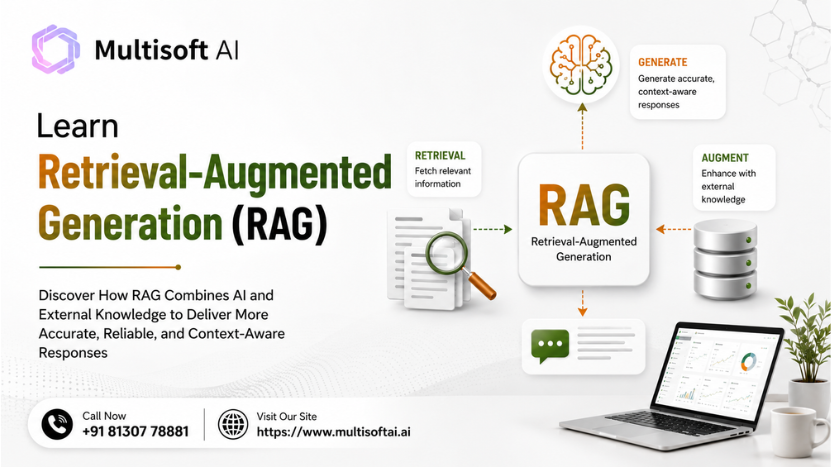
Retrieval-Augmented Generation: A Beginner's Guide to Building Smarter AI Applications
Artificial Intelligence (AI) is transforming the way people work, communicate, and solve problems across industries. From creating content and writing code to answering customer queries and analyzing data, AI-powered tools are becoming an essential part of modern businesses. However, traditional AI models often rely only on the information they were trained on, which means they may provide outdated or inaccurate responses when asked about recent events or organization-specific data. This is where Retrieval-Augmented Generation (RAG) plays a vital role. RAG enhances the capabilities of Large Language Models (LLMs) by allowing them to retrieve relevant information from trusted external sources before generating a response. As a result, AI systems become more accurate, reliable, and context-aware. Whether you are a student, software developer, AI enthusiast, or business professional, understanding Retrieval-Augmented Generation is an important step toward building smarter AI applications and staying ahead in the rapidly evolving world of Generative AI.
What Is Retrieval-Augmented Generation (RAG)?
Retrieval-Augmented Generation (RAG) Training is an advanced Artificial Intelligence (AI) technique that combines the power of Large Language Models (LLMs) with real-time information retrieval to generate more accurate and reliable responses. Unlike traditional AI models that rely only on the data used during their training, RAG first searches trusted external sources such as documents, databases, websites, PDFs, or enterprise knowledge bases to find relevant information related to a user's query. It then uses this retrieved information to create a context-aware and well-informed response. This approach helps reduce inaccurate or outdated answers, making AI systems more dependable for business and real-world applications. RAG is widely used in customer support, healthcare, education, finance, legal services, and enterprise knowledge management, where access to current and organization-specific information is essential. By combining retrieval with generation, RAG enables businesses to build smarter AI assistants, intelligent search systems, and more effective Generative AI applications.
Why Was RAG Developed?
Traditional AI language models are trained on large datasets, but their knowledge has limitations.
Some common challenges include:
- Information may become outdated.
- AI may not know company-specific data.
- Responses can sometimes be inaccurate.
- AI may generate information that does not exist.
- Sensitive business documents are not part of public training data.
RAG solves these problems by allowing AI to retrieve information from trusted sources before answering.
Instead of guessing, AI searches first and then responds.
Understanding RAG with a Simple Example
Imagine you ask an AI chatbot:
"What is our company's latest leave policy?"
A standard AI model may not know the answer because that policy is stored in your organization's HR documents.
With RAG, the AI:
- Searches the HR policy documents.
- Finds the latest version.
- Reads the relevant section.
- Generates an accurate answer based on that document.
This creates more trustworthy responses while reducing incorrect information.
How Does RAG Work?
Although the technology behind RAG is advanced, the overall process is easy to understand.
Step 1: User Asks a Question
A user enters a query such as:
"What are the benefits of cloud computing?"
Step 2: Search Relevant Information
Instead of answering immediately, the AI searches trusted knowledge sources such as:
- PDFs
- Company documents
- Databases
- Websites
- Research papers
- Product manuals
- Internal documentation
Step 3: Retrieve Relevant Content
The system identifies the most relevant sections related to the user's question.
Step 4: Generate the Final Response
The AI combines its language understanding with the retrieved information to create a complete and accurate answer.
This combination of retrieval and generation is what makes RAG so powerful.
Key Components of a RAG System
A Retrieval-Augmented Generation system consists of several important components.
Large Language Model (LLM)
The LLM understands the user's question and generates natural language responses.
Popular LLMs include:
- GPT models
- Llama
- Claude
- Gemini
- Mistral
Knowledge Base
A knowledge base contains the information that AI searches before answering.
Examples include:
- PDFs
- Word documents
- Excel files
- Company policies
- Product documentation
- Websites
- Wikis
- Research papers
Embedding Model
An embedding model converts text into numerical representations called vectors.
These vectors help AI understand the meaning of information instead of matching only exact words.
Vector Database
The vector database stores document embeddings and helps retrieve the most relevant content quickly.
Popular vector databases include:
- Pinecone
- Chroma
- Weaviate
- FAISS
- Milvus
- Qdrant
Retriever
The retriever searches the vector database and selects the most relevant information for the user's query.
Generator
The generator uses the retrieved information to create a natural, easy-to-read response.
Why Is RAG Better Than Traditional AI?
Traditional AI depends only on what it learned during training.
RAG improves this by adding access to external information.
Some major advantages include:
- More accurate answers
- Access to updated information
- Reduced AI hallucinations
- Better business applications
- Improved customer support
- Reliable responses from trusted documents
- Personalized information retrieval
Benefits of Learning Retrieval-Augmented Generation
Learning RAG offers several professional advantages.
High Industry Demand
Many organizations are adopting AI-powered search and knowledge assistants.
Professionals with RAG skills are becoming increasingly valuable.
Better AI Applications
Developers can build intelligent chatbots that answer questions using company-specific data.
Improved Decision Making
Businesses can retrieve accurate information quickly instead of manually searching through documents.
Enhanced Productivity
Employees spend less time looking for information.
AI retrieves it instantly.
Cost Savings
Companies reduce support costs by automating repetitive information requests.
Real-World Applications of RAG
RAG is being used across multiple industries.
Customer Support
AI assistants answer customer questions using product manuals and support documents
Healthcare
Doctors and researchers retrieve medical literature, treatment guidelines, and hospital protocols.
Banking
Banks use RAG to answer questions about policies, compliance, and financial products.
Education
Students receive answers based on textbooks, lecture notes, and research materials.
Human Resources
Employees ask questions about:
- Leave policies
- Benefits
- Payroll
- Company guidelines
Legal Services
Law firms retrieve information from contracts and legal documents.
Manufacturing
Engineers search technical manuals and maintenance documentation.
Research
Researchers quickly locate relevant information across thousands of documents.
RAG vs Traditional AI Models
Understanding the difference helps beginners appreciate why RAG is important.
| Traditional AI | Retrieval-Augmented Generation |
| Answers from training data | Answers using retrieved information |
| Knowledge becomes outdated | Uses current documents |
| Higher chance of hallucination | More reliable responses |
| Limited company knowledge | Accesses private business data |
| Difficult to update | Easy to update by adding documents |
Essential Skills Needed to Learn RAG
Beginners do not need to master everything at once.
Helpful skills include:
- Basic Python programming
- AI fundamentals
- Machine Learning basics
- Natural Language Processing (NLP)
- Understanding of APIs
- Prompt Engineering
- Vector databases
- Embeddings
- Large Language Models
Even if you are new to AI, you can start learning these concepts step by step.
Popular Tools Used in RAG Development
Several modern tools help developers build RAG applications.
Some popular technologies include:
- LangChain
- LlamaIndex
- OpenAI APIs
- Hugging Face
- Pinecone
- FAISS
- ChromaDB
- Weaviate
- Milvus
- Qdrant
- Python
- FastAPI
- Streamlit
Learning these tools can help you create intelligent AI-powered applications.
Who Should Learn Retrieval-Augmented Generation?
RAG is useful for professionals from many backgrounds.
Software Developers
Build AI-powered applications.
Data Scientists
Create intelligent search systems.
AI Engineers
Develop enterprise AI solutions.
Machine Learning Engineers
Improve LLM performance.
Cloud Professionals
Deploy scalable AI applications.
Business Analysts
Use AI for knowledge management.
IT Professionals
Implement AI assistants for internal teams.
Students
Build practical AI projects for portfolios.
Career Opportunities After Learning RAG
As businesses invest more in Generative AI, professionals with RAG expertise are becoming highly sought after.
Potential career roles include:
- AI Engineer
- Generative AI Engineer
- Machine Learning Engineer
- NLP Engineer
- Data Scientist
- AI Solutions Architect
- Prompt Engineer
- Python Developer
- LLM Application Developer
- AI Consultant
These roles are in demand across technology companies, healthcare, finance, manufacturing, education, retail, and consulting.
Common Beginner Mistakes
Many beginners make a few common mistakes while learning RAG.
Ignoring Data Quality
AI can only provide good answers if the documents are accurate and up to date.
Choosing the Wrong Embedding Model
The quality of document retrieval depends heavily on embeddings.
Using Poor Prompt Design
Clear prompts improve the final response.
Skipping Testing
Every RAG application should be tested with real user questions.
Not Updating the Knowledge Base
Adding updated documents keeps the AI accurate over time.
Tips for Learning Retrieval-Augmented Generation Faster
Here are some practical ways to build your skills:
- Learn the basics of Generative AI.
- Understand how Large Language Models work.
- Practice Python programming.
- Explore vector databases.
- Build small RAG projects.
- Experiment with LangChain and LlamaIndex.
- Learn Prompt Engineering techniques.
- Read AI research blogs and documentation.
- Participate in hands-on labs and assignments.
Consistent practice is the best way to become confident with RAG.
Why Businesses Are Investing in RAG
Organizations generate massive amounts of information every day.
Employees often struggle to find the right document quickly.
RAG helps businesses by:
- Improving customer service
- Increasing employee productivity
- Reducing search time
- Supporting informed decision-making
- Delivering consistent answers
- Enhancing knowledge management
- Reducing operational costs
As AI adoption grows, RAG is becoming an essential technology for enterprise AI solutions.
Why Professional Training Matters
While free online resources can introduce the basics, structured learning provides a faster and more practical path.
A comprehensive Retrieval-Augmented Generation (RAG) Training program typically includes:
- Fundamentals of Generative AI and LLMs
- Prompt Engineering techniques
- Document preprocessing and chunking
- Embedding models and semantic search
- Vector databases such as FAISS, Pinecone, and ChromaDB
- LangChain and LlamaIndex frameworks
- Building end-to-end RAG applications
- Hands-on projects using real-world datasets
- Best practices for deploying AI solutions
Working on practical projects under expert guidance helps learners gain confidence and develop skills that employers value.
Conclusion
Retrieval-Augmented Generation (RAG) is redefining how businesses and professionals use Artificial Intelligence by combining the reasoning capabilities of Large Language Models with access to trusted, up-to-date information. Unlike traditional AI models that rely only on pre-trained knowledge, RAG delivers more accurate, relevant, and context-aware responses by retrieving data from external sources before generating answers. This makes it an ideal solution for building intelligent chatbots, enterprise search systems, customer support assistants, and knowledge management platforms. As the adoption of Generative AI continues to grow, organizations are actively seeking professionals who understand RAG and can develop practical AI applications. Whether you are a student, software developer, data scientist, or IT professional, learning RAG can significantly enhance your career prospects.
By gaining hands-on experience through a structured training program, you can build the skills needed to create smarter AI solutions and stay competitive in today's rapidly evolving technology landscape. Enroll in Multisoft Ai now!
About the Author