- Overview of AI application deployment
- AI deployment lifecycle
- Development vs. production environments
- Common deployment architectures
- Challenges in deploying AI applications
- Industry use cases and best practices
- Model serialization and packaging
- Managing model artifacts
- Model optimization techniques
- Version control for AI models
- Dependency management
- Environment configuration
- Python deployment essentials
- Virtual environments
- Package management with pip and Conda
- Logging and error handling
- Configuration management
- Writing production-ready Python code
- Introduction to REST APIs
- Creating APIs using FastAPI
- Flask for AI applications
- API routing and endpoints
- Request and response handling
- Authentication and authorization
- API documentation using Swagger/OpenAPI
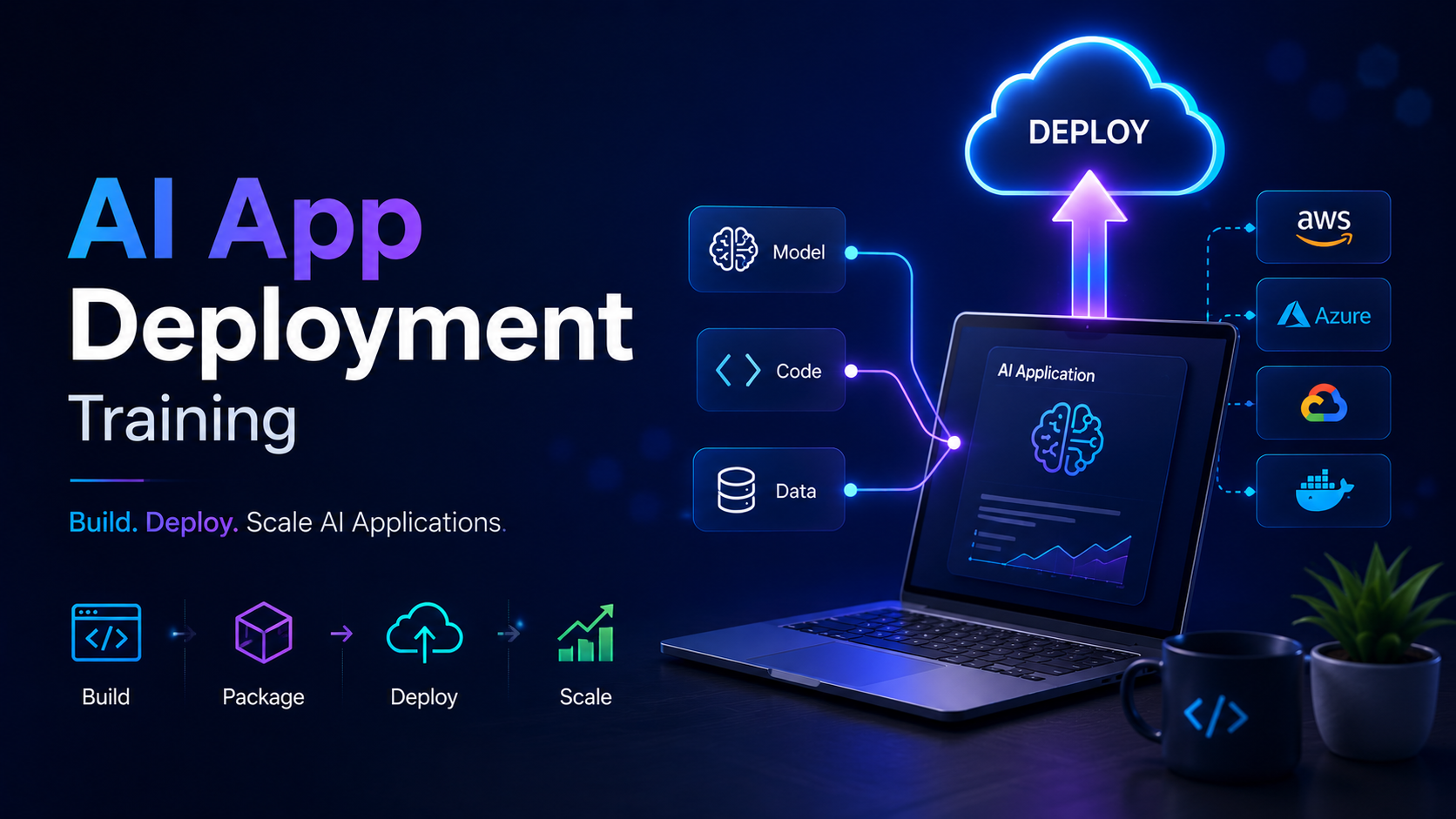
- Introduction to Docker
- Docker architecture
- Creating Dockerfiles
- Building Docker images
- Managing containers
- Docker Compose
- Best practices for AI containers
- Introduction to Kubernetes
- Kubernetes architecture
- Pods, Deployments, and Services
- ConfigMaps and Secrets
- Scaling AI applications
- Rolling updates and rollbacks
- Monitoring Kubernetes workloads
- Cloud deployment fundamentals
- Deploying AI applications on AWS
- Deploying AI applications on Microsoft Azure
- Deploying AI applications on Google Cloud Platform (GCP)
- Serverless AI deployment
- Cloud storage integration
- Load balancing and auto-scaling
- Introduction to MLOps
- ML lifecycle management
- Model versioning
- Experiment tracking
- Continuous Integration (CI)
- Continuous Deployment (CD)
- Continuous Training (CT)
- DevOps concepts for AI
- Git and GitHub workflows
- GitHub Actions
- Jenkins pipelines
- Automated testing
- Deployment automation
- Release management
- Monitoring deployed models
- Model drift detection
- Performance metrics
- Logging and observability
- Alerting mechanisms
- Retraining strategies
- AI application security fundamentals
- Identity and access management
- API security
- Secure container practices
- Data encryption
- Secret management
- Compliance and governance
- Horizontal and vertical scaling
- High availability
- Load balancing
- Caching strategies
- Performance optimization
- Cost optimization
- Disaster recovery planning
- Introduction to LLM deployment
- Hosting open-source LLMs
- API-based LLM deployment
- Prompt serving architectures
- GPU deployment considerations
- Performance optimization for LLM inference
- Monitoring LLM applications
- Integrating AI with enterprise applications
- Database connectivity
- Event-driven architectures
- Messaging systems
- Third-party API integration
- Microservices architecture
- Unit testing AI applications
- Integration testing
- Performance testing
- Debugging deployment issues
- Log analysis
- Root cause analysis
- Deployment rollback strategies
- Design a production-ready AI application
- Package and containerize the solution
- Build REST APIs
- Deploy on a cloud platform
- Configure CI/CD pipelines
- Implement monitoring and logging
- Secure the application
- Performance tuning and optimization
- Final project presentation and deployment review

 Explore a Multiple AI Tools
 Unlimited Practice Assessments
 Lifetime LMS Access
 Recorded Live Sessions
 Beginner
 Certification